What Distinguishes a Power Amplifier from a Standard Amplifier
Understanding the technical and functional differences between power amplifiers and standard (voltage) amplifiers is essential for anyone designing, installing, or upgrading an audio system. This guide breaks down the design intent, signal behavior, applications, and selection criteria.
Table of Contents
Core Definitions
A standard amplifier — most often called a voltage amplifier or pre-amplifier — is designed to take a low-level audio signal and increase its voltage so it can drive the next stage in the signal chain. Its primary job is to raise signal amplitude without delivering significant current to a load.
A power amplifier, by contrast, accepts an already-amplified line-level signal and converts it into a high-current output capable of moving speakers, subwoofers, or large-scale PA loads. It is the final stage before the transducer.
Voltage amplifier → boosts signal level. Power amplifier → drives the load.
How Each Amplifier Works
Standard (Voltage) Amplifier
A standard amplifier operates in the small-signal region of an active device. It uses modest bias currents, low power supply rails, and high impedance input stages to amplify voltage with minimal noise. The output stage is typically a Class A buffer or emitter follower that cannot source substantial current.
Power Amplifier
A power amplifier operates in the large-signal region. It uses high-current output devices (bipolar transistors, MOSFETs, or class-D switching stages), robust heat-sinking, and power supply rails sized to deliver continuous current into low-impedance loads — typically 4 Ω or 8 Ω loudspeakers.
Key Technical Differences
| Parameter | Standard Amplifier | Power Amplifier |
|---|---|---|
| Primary Function | Voltage gain | Current / power delivery |
| Load Drive | High impedance (kΩ) | Low impedance (4–8 Ω speakers) |
| Output Stage | Small-signal transistors | High-current discrete or class-D devices |
| Power Supply | Low current rails | High-current, regulated rails |
| Minimal heat-sinking | Large heat-sinks or forced cooling | |
| Efficiency | Not a primary concern | Class A / AB / D efficiency varies widely |
| Location in Chain | Early / mid stages | Final stage before speakers |
Typical Applications
- Standard amplifiers: microphone preamps, instrument pickups, mixing console input stages, op-amp buffers, RIAA phono stages.
- Power amplifiers: home hi-fi systems, studio monitors, live concert PA, cinema sound, subwoofer amplification, public-address installations.
How to Choose the Right Amplifier
Selection depends on where the amplifier sits in the signal chain and what it must drive.
- Match the amplifier to the load: low-impedance speakers require a power amplifier rated for the appropriate impedance.
- Consider headroom: a power amplifier should deliver 1.5–2× the continuous RMS needed for dynamic musical peaks.
- Mind the environment: live and touring rigs benefit from class-D efficiency and lower thermal footprint.
- Check connectivity: balanced inputs (XLR / TRS) reduce noise over long cable runs in professional installs.
Frequently Asked Questions
Can a power amplifier be used without a preamplifier?
Yes, if the source already provides line-level signal. Many modern power amps accept balanced or unbalanced line input directly.
Are integrated amplifiers a compromise?
They combine preamp and power amp stages in one chassis. Quality integrated designs can rival separates when engineered carefully.
Does more wattage always mean better sound?
Not necessarily. Sound quality depends on design, distortion profile, damping factor, and how well the amplifier controls the speaker load.
Building a High-Performance Audio System?
Match your amplifier topology to your speakers and room for clean, dynamic playback.
Explore Amplifier Solutions-
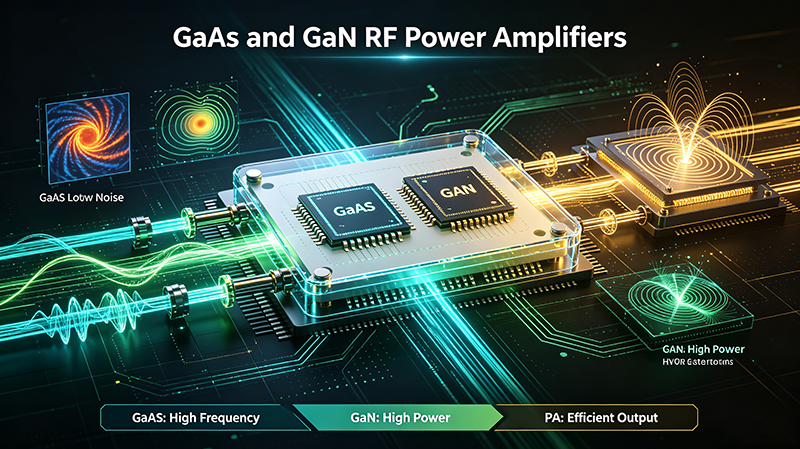
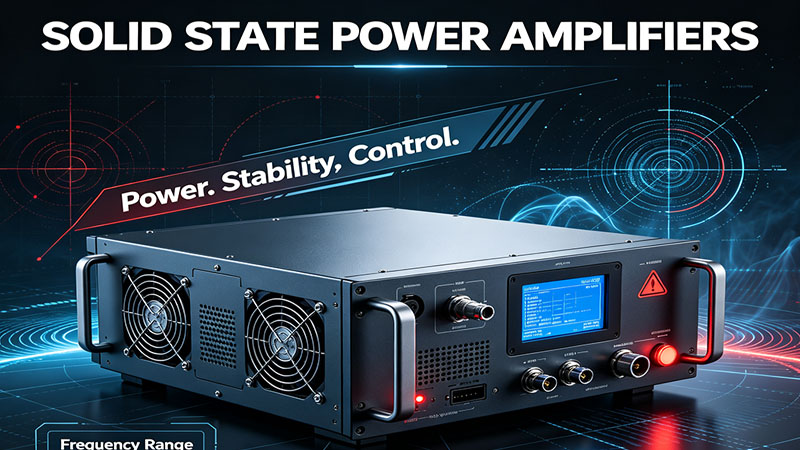
Learn how power amplifiers work, explore the different amplifier classes, understand their key specifications, and discover why high-performance RF and microwave power amplifiers are essential for modern communication, radar, testing, broadcasting, and industrial applications.Aug 20 ,26
-
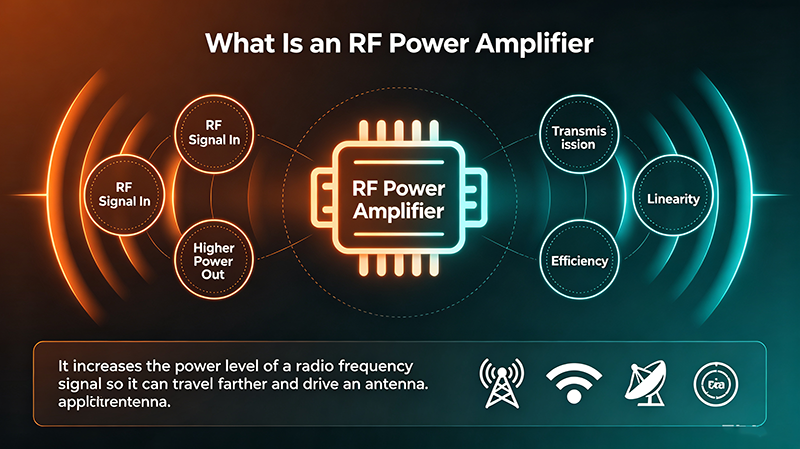
An RF power amplifier (RF PA) is an electronic device designed to increase the power level of a radio-frequency signal before it is transmitted to an antenna, load, or another RF system.Aug 19 ,26
About the Author — MeiXun Team
Chief Engineer Wang
High-tech Enterprise, Feifeng Talent
Chief Engineer Wang graduated with a master's degree in high-power microwave from the Institute of Electronics, University of Chinese Academy of Sciences.
View Full Profile- RF Microwave Components Manufacturers
- RF Switch Circuit Diagram
- RF Switch
- RF Connector
- SMA Connector
- RF Switch Module
- RF Coupler
- RF PIN Switch
- Microwave Coaxial Switch
- PIN Switch
- Coaxial RF Switch
- Waveguide Switch
- Microwave Switch
- RF Microwave Switch Manufacturers
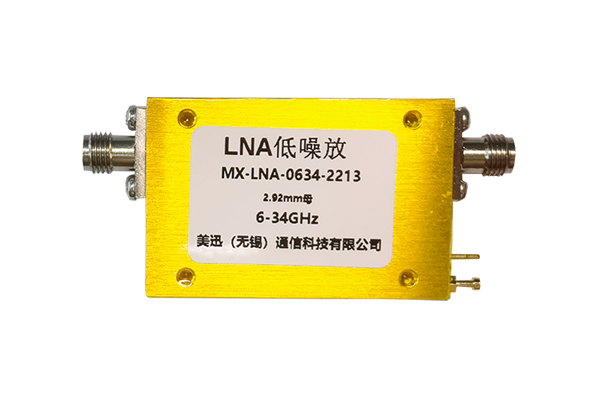
- Low Noise Amplifier
- PIN Diode Switch
- Coaxial Switch
- RF Microwave Switch