





Table of Contents
What Is a Power Amplifier?
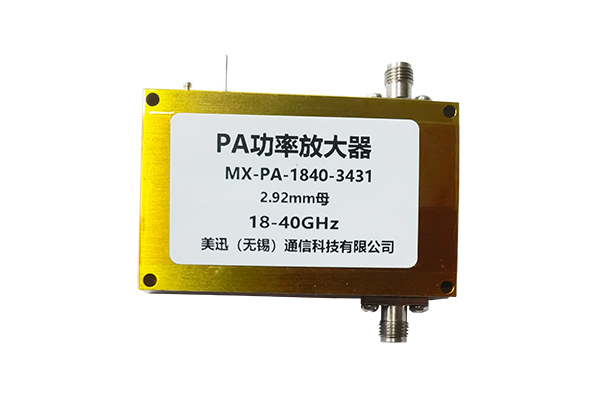
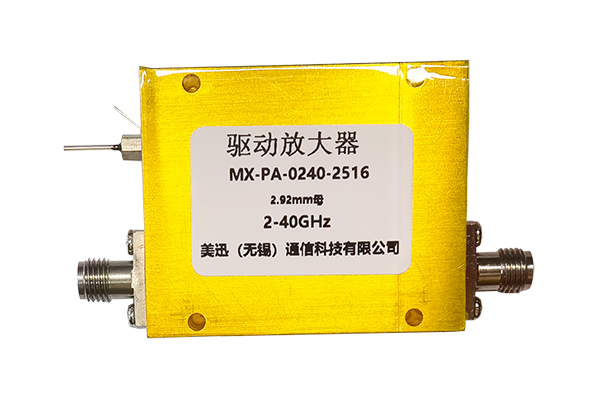
A power amplifier is an electronic device designed to increase the power level of an input signal so that the signal can drive a load, transmit over a long distance, or deliver sufficient energy to another system. Unlike low-level signal amplifiers that primarily focus on voltage gain, a power amplifier is specifically engineered to provide meaningful output power while maintaining acceptable efficiency, linearity, stability, and signal quality.
Power amplifiers are used throughout modern electronics. In RF and microwave systems, they increase the power of radio-frequency signals before transmission through an antenna. In audio systems, they provide enough power to drive loudspeakers. In industrial and scientific equipment, they can deliver controlled RF energy for testing, heating, plasma generation, and other specialized processes.
For RF and microwave applications, a typical signal chain may look like this:
The power amplifier is often one of the most critical stages in the entire system because its performance can directly influence transmission range, signal quality, power consumption, thermal management, and overall system reliability.
How Does a Power Amplifier Work?
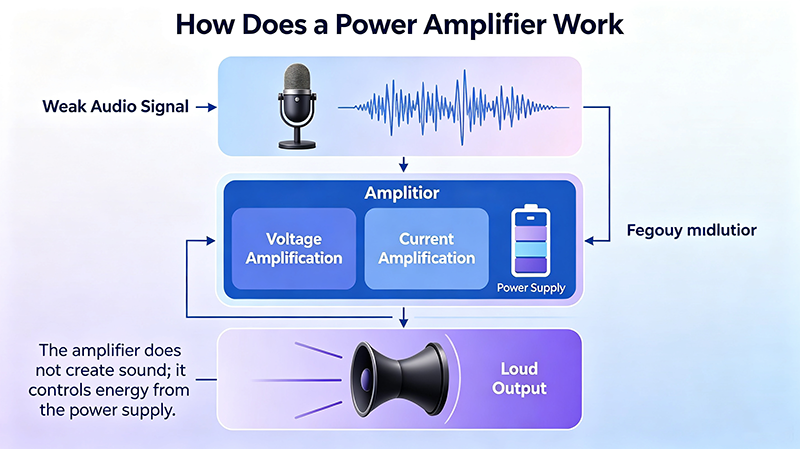
The fundamental operating principle of a power amplifier is based on using energy from a DC power supply to create a higher-power replica of the input signal. The input signal controls the active device, while the DC supply provides the energy that is converted into RF, microwave, or audio output power.
1. The Input Signal Controls the Active Device
A relatively low-power input signal is applied to an active semiconductor device such as a transistor, FET, MOSFET, GaAs device, or GaN device. The characteristics of the input signal control the current or voltage behavior of the active device.
2. DC Energy Is Converted into Signal Power
The active device draws energy from the DC power supply. Through controlled operation, this energy is transferred to the output signal, increasing the signal's power level.
3. Matching Networks Optimize Power Transfer
Input and output matching networks are often used to maximize power transfer and achieve the desired impedance environment. In many RF systems, the standard system impedance is 50 ohms, but the optimum impedance seen by the transistor may be different. Proper matching is therefore essential.
4. The Output Network Delivers the Amplified Signal
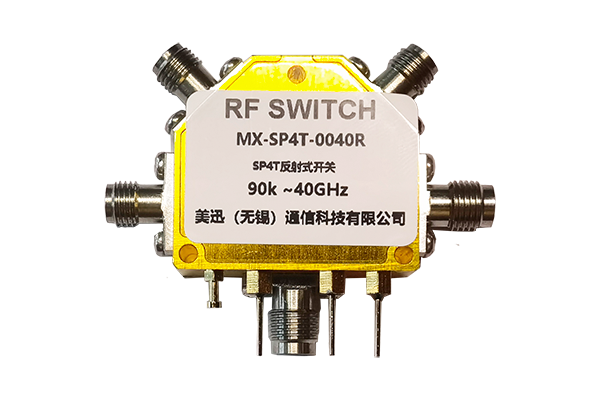
The amplified signal is routed to the next stage of the system, such as an antenna, RF switch, directional coupler, test device, filter, or other load. Additional filtering may be required to suppress harmonics and unwanted emissions.
Key Benefits of Power Amplifiers
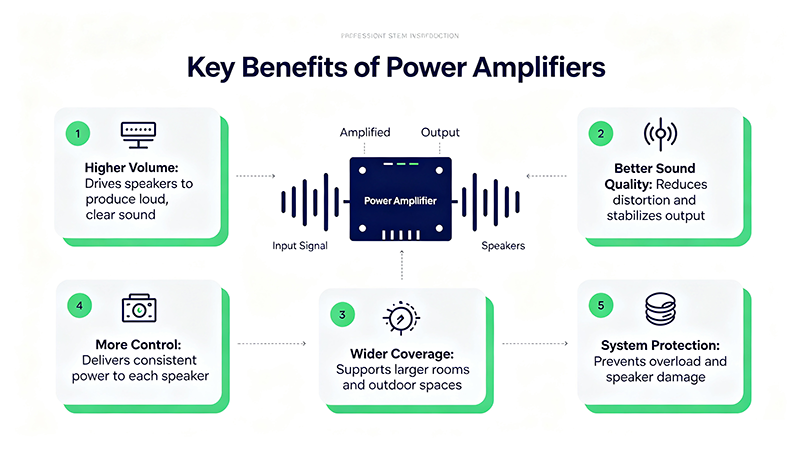
The main purpose of a power amplifier is to increase signal power, but the benefits extend far beyond simple amplification. A properly selected power amplifier can significantly improve the performance and capability of an entire electronic system.
Higher Output Power
Enables a low-power source to drive antennas, transmitters, speakers, test loads, and other power-demanding devices.
Extended Communication Range
Higher transmitted RF power can improve link performance and extend communication distance when system regulations and link budgets permit.
Improved System Performance
Provides the power required for demanding applications such as radar, satellite communication, electronic warfare, and high-frequency testing.
Better Signal Control
Modern amplifier designs can provide controlled gain, power levels, linearity, and bandwidth for complex system requirements.
High-Frequency Capability
Advanced semiconductor technologies allow power amplification from low frequencies into the microwave and millimeter-wave spectrum.
Compact System Design
Modern solid-state power amplifiers can provide high power density, helping engineers reduce equipment size and weight.
Why Power Amplifiers Matter in RF Systems
In wireless systems, transmitted power is an important part of the overall link budget. The power amplifier provides the energy necessary for the signal to overcome path loss, environmental attenuation, antenna losses, and other transmission challenges. However, maximum power is not always the goal. Engineers must balance output power with efficiency, linearity, bandwidth, thermal performance, and regulatory requirements.
Types and Classes of Power Amplifiers
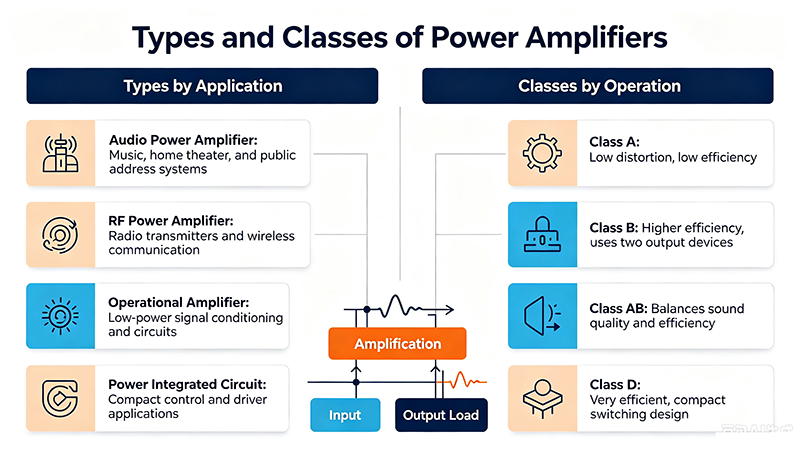
Power amplifiers can be classified in several ways, including frequency range, semiconductor technology, operating mode, output power, and amplifier class. Amplifier classes are especially important because they influence efficiency and linearity.
| Amplifier Class | Typical Characteristics | Main Advantage | Common Applications |
|---|---|---|---|
| Class A | Device conducts throughout the entire signal cycle | Excellent linearity | High-fidelity and linear RF applications |
| Class B | Each device conducts for approximately half of the cycle | Higher efficiency than Class A | Push-pull amplifier designs |
| Class AB | Conduction is greater than Class B but less than Class A | Good balance of linearity and efficiency | RF transmitters and audio systems |
| Class C | Conduction occurs for less than half of the cycle | High efficiency | Tuned RF applications |
| Class D | Switching operation using pulse-based techniques | Very high efficiency | Audio and switching power systems |
| Class E/F | Switching or harmonic-tuned operation | Excellent efficiency at suitable frequencies | RF and specialized high-efficiency systems |
Solid-State Power Amplifiers
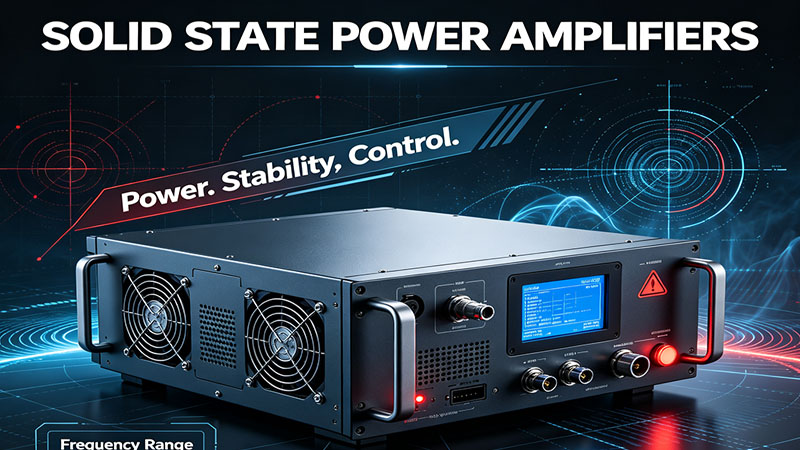
Solid-state power amplifiers, commonly called SSPAs, use semiconductor devices rather than vacuum tubes. They are widely used because of their compact size, fast operation, high reliability, and compatibility with modern electronic systems.
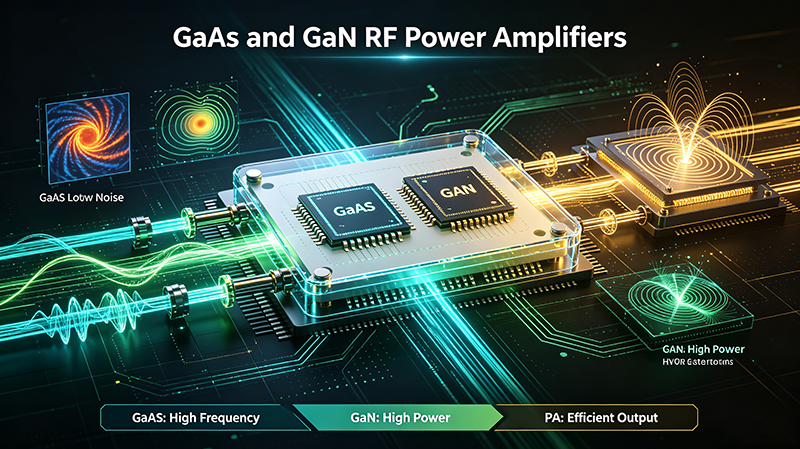
Common semiconductor technologies include silicon LDMOS, GaAs, GaN, and SiGe-based devices. Among these, GaN power amplifiers have become particularly important for high-power and high-frequency applications because gallium nitride devices can support high voltage, high power density, and excellent RF performance.
RF and Microwave Power Amplifiers
RF power amplifiers are designed for radio-frequency signals, while microwave power amplifiers operate at higher frequencies. These amplifiers are commonly found in communication systems, radar, satellite terminals, wireless infrastructure, electronic warfare equipment, and laboratory test systems.
Important Power Amplifier Specifications
Choosing the right power amplifier requires more than simply comparing output power. Several electrical and mechanical specifications should be evaluated together.
Frequency Range
The operating frequency range defines where the amplifier can provide its specified performance. Some amplifiers are narrowband and optimized for a specific frequency band, while broadband amplifiers support a wider frequency range.
Output Power
Output power is usually specified in watts or dBm. Engineers should distinguish between saturated output power, linear output power, CW power, peak power, and pulsed power.
For example, 30 dBm equals 1 watt, while 40 dBm equals 10 watts.
Power Gain
Gain describes the increase in signal power from input to output and is typically expressed in decibels.
High gain can reduce the amount of input drive required, but excessive gain may increase the risk of instability or make system-level power control more difficult.
Efficiency
Efficiency describes how effectively the amplifier converts DC input power into useful output power. Higher efficiency reduces power consumption and heat generation.
Power-Added Efficiency
Power-added efficiency, or PAE, is particularly important in RF amplifier design because it accounts for the difference between output and input RF power relative to the DC power consumed.
Linearity
Linearity determines how accurately the output signal follows the input signal. Poor linearity can produce harmonic distortion, intermodulation products, spectral regrowth, and degraded communication quality.
P1dB Compression Point
The 1 dB compression point indicates the approximate output power level at which amplifier gain has decreased by 1 dB from its small-signal value. It is commonly used as an indicator of the amplifier's usable power capability.
IP3
The third-order intercept point is an important indicator of nonlinear performance. A higher IP3 generally indicates better resistance to third-order intermodulation distortion.
Harmonics and Spurious Signals
Power amplifiers may generate unwanted frequency components. Filters and optimized circuit design are often required to meet system performance and regulatory requirements.
VSWR and Return Loss
Impedance mismatch at the input or output can reduce power transfer and create reflected power. Good VSWR and return loss performance are especially important in high-power RF systems.
Common Applications of Power Amplifiers
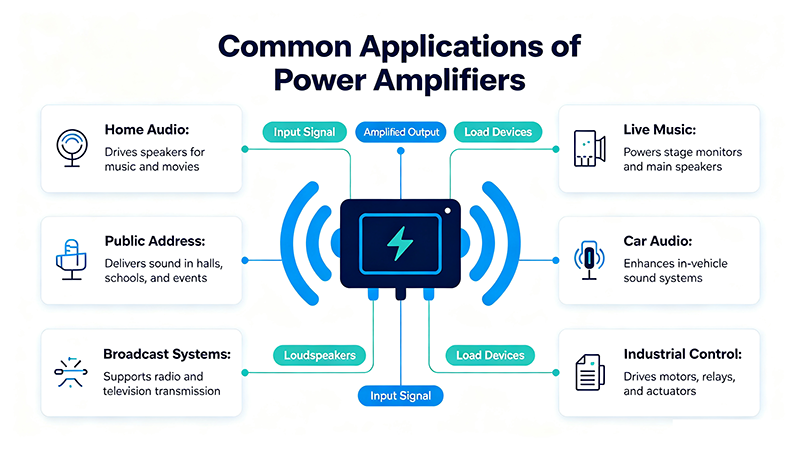
Wireless Communication
Power amplifiers are essential components in cellular networks, base stations, radio transmitters, wireless infrastructure, and other communication systems.
5G and Advanced Wireless Networks
Modern wireless networks require power amplifiers that can support demanding bandwidth, modulation, efficiency, and linearity requirements. Advanced semiconductor technologies and digital linearization techniques are often used to optimize performance.
Radar Systems
Radar transmitters require high-power RF or microwave signals to illuminate targets and support detection over significant distances. Power amplifiers may be designed for CW, pulsed, or high-peak-power operation depending on the radar architecture.
Satellite Communication
Satellite communication systems use power amplifiers in ground terminals, gateways, and space-related RF subsystems. Size, weight, power consumption, frequency coverage, and reliability are all important selection factors.
Electronic Warfare
Electronic warfare systems may require broadband, high-power, and rapidly controllable RF amplification for jamming, signal generation, and other advanced electromagnetic applications.
RF and Microwave Testing
Laboratories and automated test environments use broadband power amplifiers to increase signal levels for component characterization, antenna testing, EMC testing, and system verification.
Broadcasting
Radio and television transmission systems depend on power amplifiers to generate the required transmitter output power for coverage and signal delivery.
Industrial and Scientific Systems
High-power amplifiers are also used in plasma generation, RF heating, material processing, particle accelerators, scientific instruments, and other specialized applications.
How to Choose the Right Power Amplifier
Selecting a power amplifier should begin with the requirements of the complete system. The best amplifier is not necessarily the one with the highest output power. It is the one that provides the required performance with appropriate efficiency, reliability, and operating margin.
- Define the frequency range. Confirm the minimum and maximum frequencies required by the application.
- Determine the required output power. Consider continuous, peak, pulsed, and linear operating requirements.
- Calculate the required gain. Identify the available input power and the output level needed.
- Evaluate linearity requirements. Complex modulation formats may require excellent linear performance.
- Check efficiency. Higher efficiency can reduce operating costs and simplify thermal management.
- Review impedance matching. Confirm compatibility with the system impedance, often 50 ohms in RF applications.
- Consider bandwidth. Narrowband designs may offer optimized performance, while broadband amplifiers provide greater flexibility.
- Assess thermal conditions. Verify heat dissipation, cooling methods, and operating temperature limits.
- Check reliability requirements. Critical applications may require long service life, protection circuits, and high-quality components.
- Consider physical integration. Evaluate size, connectors, supply voltage, control interfaces, and mounting requirements.
Common Power Amplifier Challenges and Optimization Tips
Thermal Management
High output power and low efficiency can generate significant heat. Effective heat sinks, thermal interface materials, forced-air cooling, liquid cooling, and optimized chassis design may be required.
Nonlinear Distortion
Operating too close to saturation can degrade linearity. Engineers may use output back-off, predistortion, feedforward techniques, or optimized bias conditions to improve signal quality.
Impedance Mismatch
Poor matching can cause reflected power, reduced output, and possible damage in high-power systems. Proper matching networks, isolators, circulators, and high-quality RF connectors can help protect the amplifier.
Stability
Amplifiers can oscillate if the circuit is not properly stabilized. Careful layout, grounding, shielding, bias design, decoupling, and stability analysis are essential.
Power Supply Quality
Noise, voltage variation, or insufficient current capability can negatively affect amplifier performance. A stable and adequately rated power supply is critical.
Load Protection
Some advanced power amplifiers include protection against over-temperature, over-current, excessive reflected power, and over-voltage conditions. These features can significantly improve system reliability.
Power Amplifier Technology Trends
The power amplifier industry continues to evolve as communication systems and high-frequency applications demand higher performance.
- GaN technology: Increasingly used for high-power, high-frequency, and high-efficiency RF applications.
- Higher power density: Enables smaller and lighter amplifier systems.
- Broadband designs: Support flexible multi-band and wide-frequency applications.
- Digital predistortion: Helps improve linearity and efficiency in modern communication systems.
- Integrated protection and monitoring: Provides real-time information about temperature, power, voltage, and reflected power.
- Advanced thermal packaging: Improves reliability in compact high-power systems.
- Millimeter-wave development: Supports emerging high-frequency communication, sensing, and radar applications.
Frequently Asked Questions About Power Amplifiers
What is the main purpose of a power amplifier?
The main purpose of a power amplifier is to increase the power level of an input signal so it can drive a load, transmit through an antenna, or perform another power-demanding function.
What is the difference between a power amplifier and a voltage amplifier?
A voltage amplifier primarily increases signal voltage, while a power amplifier is designed to deliver increased power to a load. Power amplifiers typically handle higher current and output energy.
What does 30 dBm mean?
30 dBm corresponds to 1 watt of power. Every 10 dB increase represents a tenfold increase in power, so 40 dBm equals 10 watts.
Which power amplifier class is the most efficient?
Efficiency depends on the operating architecture and application. Switching classes such as Class D, Class E, and Class F can achieve very high efficiency, while Class A generally offers excellent linearity at lower efficiency.
What is a solid-state power amplifier?
A solid-state power amplifier uses semiconductor devices such as transistors to amplify power. Solid-state designs are widely used because they can provide compact size, high reliability, and flexible integration.
Why is linearity important in an RF power amplifier?
Linearity is important because nonlinear amplification can create harmonics and intermodulation distortion. Good linearity helps maintain signal quality and reduce unwanted emissions.
Conclusion
Power amplifiers are fundamental components in modern electronic and RF systems. From wireless communication and 5G infrastructure to radar, satellite communication, broadcasting, and microwave testing, they provide the energy needed to transform low-level signals into useful high-power outputs.
The key to successful power amplifier selection is balancing output power, gain, efficiency, linearity, frequency range, thermal performance, reliability, and system integration. Understanding these parameters allows engineers to select an amplifier that meets real-world requirements rather than simply choosing the highest-power option.
As technologies such as GaN, broadband RF systems, digital linearization, and millimeter-wave communications continue to develop, modern power amplifiers will become even more efficient, compact, intelligent, and essential to next-generation electronic systems.