





Table of Contents
An RF microwave switch is a critical component in wireless communication systems, radar systems, and test equipment. It enables the routing of RF and microwave signals between different paths, allowing engineers to control signal flow without manual intervention. Whether you're designing a telecommunications network, building a test bench, or developing a defense system, understanding RF switches is essential.
What Is an RF Microwave Switch?
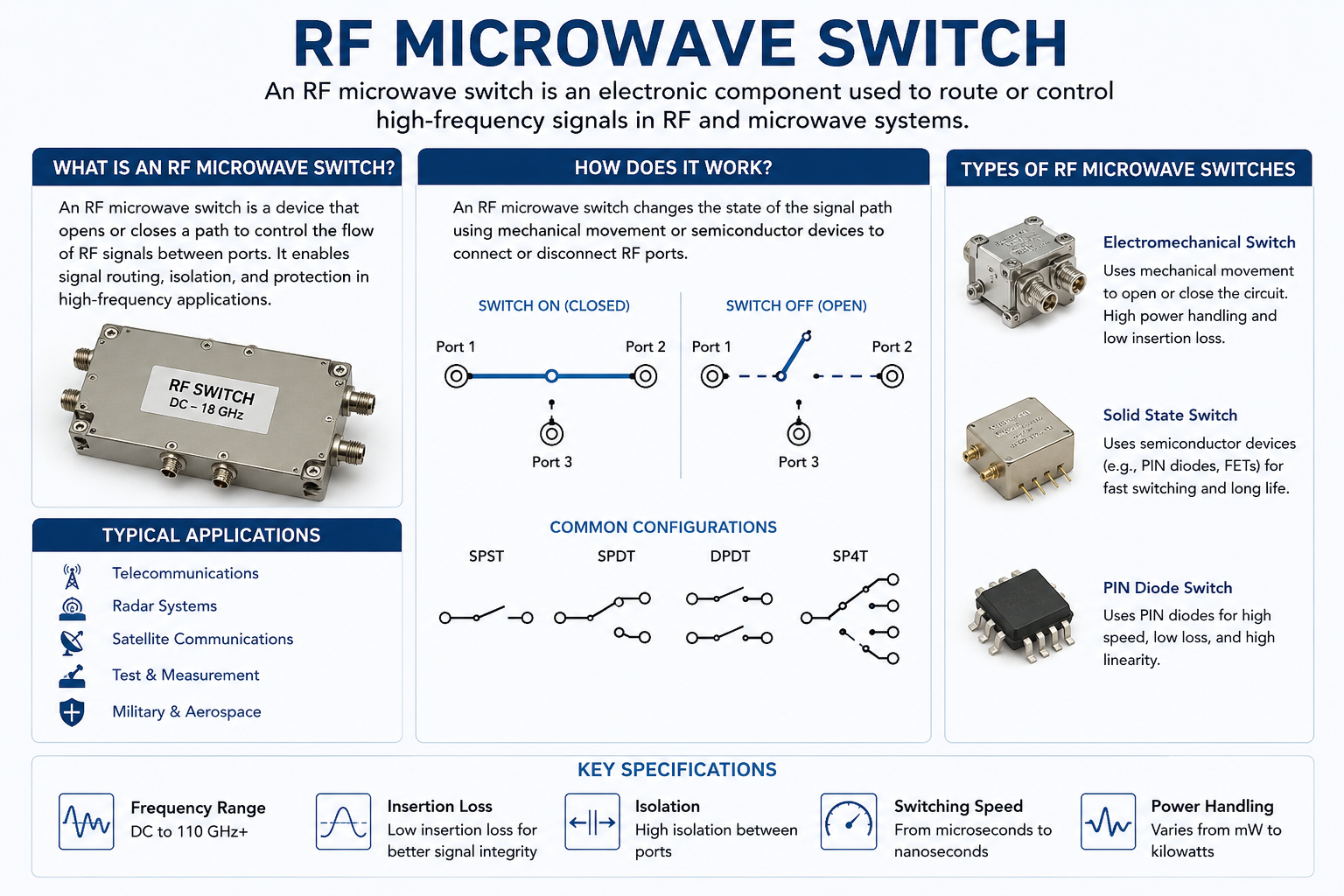
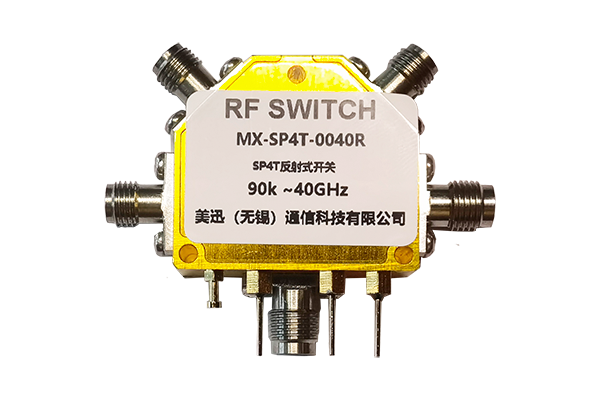
An RF microwave switch is an electronic device that controls the routing of radio frequency (RF) and microwave signals. It acts as a single-pole multiple-throw (SPMT) or multi-pole multiple-throw (MPMT) switch, directing signals from one input to multiple outputs or vice versa.
These switches are designed to handle frequencies ranging from DC to over 100 GHz, making them suitable for applications in:
- Cellular base stations and mobile networks
- Satellite communications
- Radar and electronic warfare systems
- Test and measurement equipment
- Medical imaging and treatment devices
- Industrial process control
Key Takeaway
RF microwave switches provide the flexibility needed in modern communication systems, allowing dynamic signal routing without compromising signal integrity or introducing significant losses.
Types of RF Microwave Switches
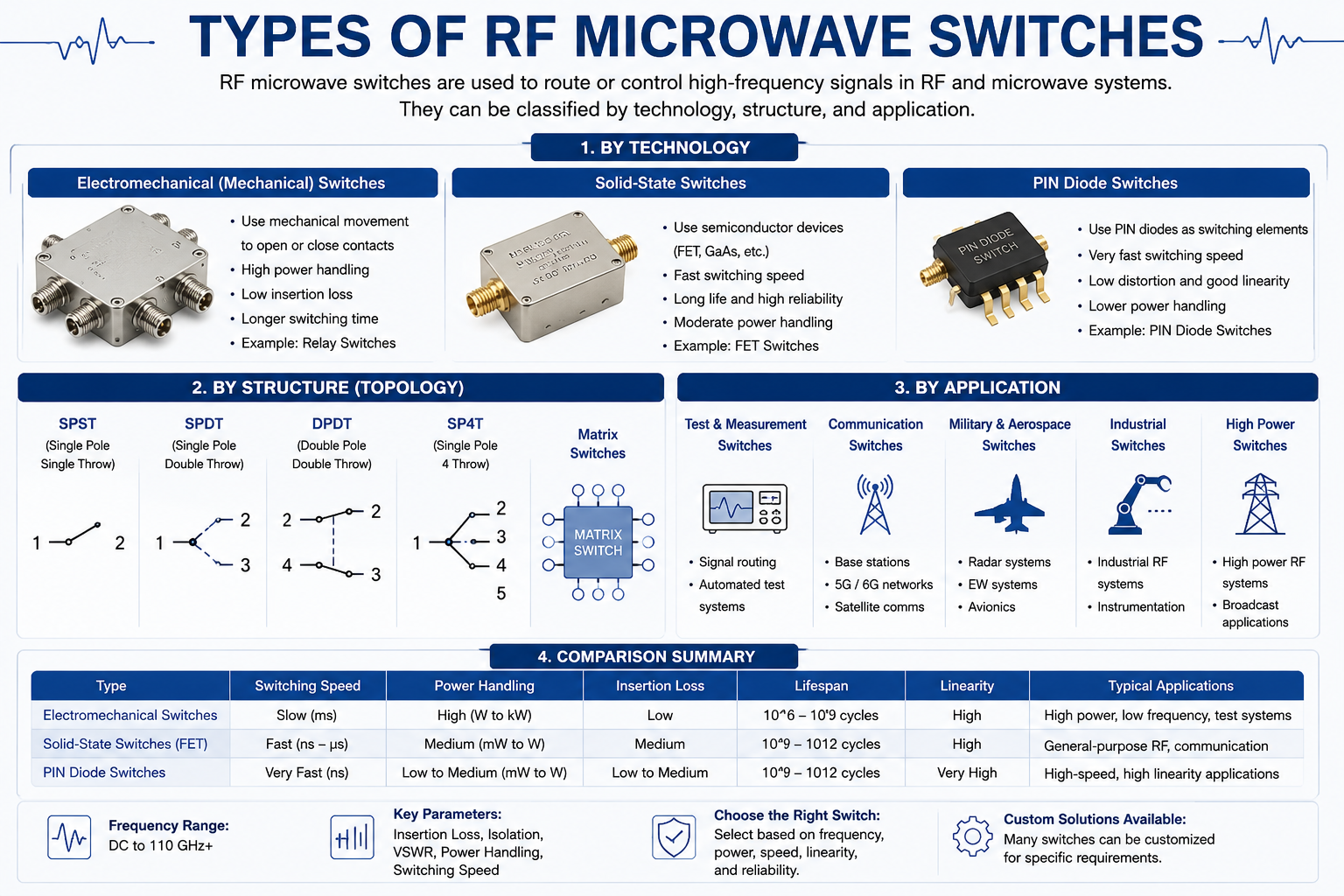
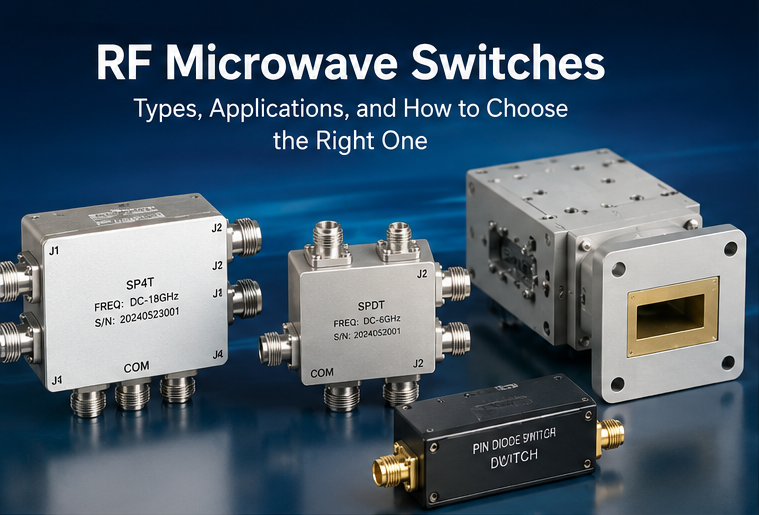
RF microwave switches come in several types, each with distinct characteristics suited for different applications. Understanding the differences helps in selecting the right switch for your requirements.
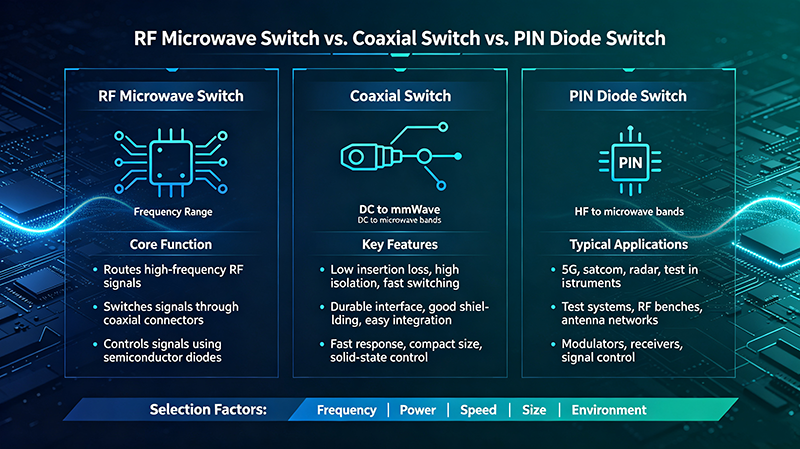
1. Electromechanical Switches
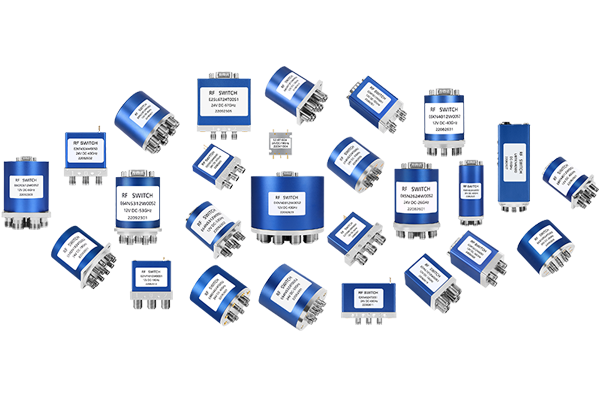
Electromechanical switches use physical relays to redirect signals. They offer excellent RF performance with low insertion loss and high isolation.
- RF relays: Use magnetic coils to move contacts
- Coaxial switches: Designed for high-frequency applications up to 26.5 GHz and beyond
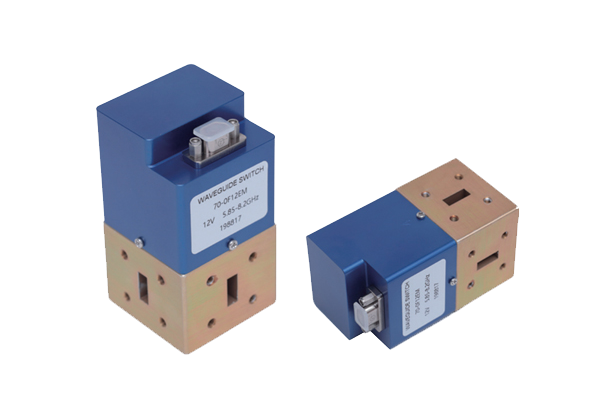
- Waveguide switches: Handle millimeter-wave frequencies
2. Solid-State Switches
Solid-state switches use semiconductor devices like PIN diodes, FETs, or GaN/GaAs transistors to switching signals electronically.
- PIN diode switches: Fast switching speed, moderate power handling
- FET switches: Low insertion loss, excellent isolation
- GaN switches: High power handling capability
3. Optical Switches
For fiber optic applications, optical switches route light signals rather than electrical signals, offering extremely low crosstalk and high bandwidth.
Electromechanical
Pros: Best RF performance, high isolation, handles high power
Cons: Slower switching, mechanical wear
Best for: Test equipment, high-power applications
Solid-State
Pros: Fast switching, long life, compact size
Cons: Higher insertion loss, limited power
Best for: High-speed switching, telecom systems
How Does an RF Microwave Switch Work?
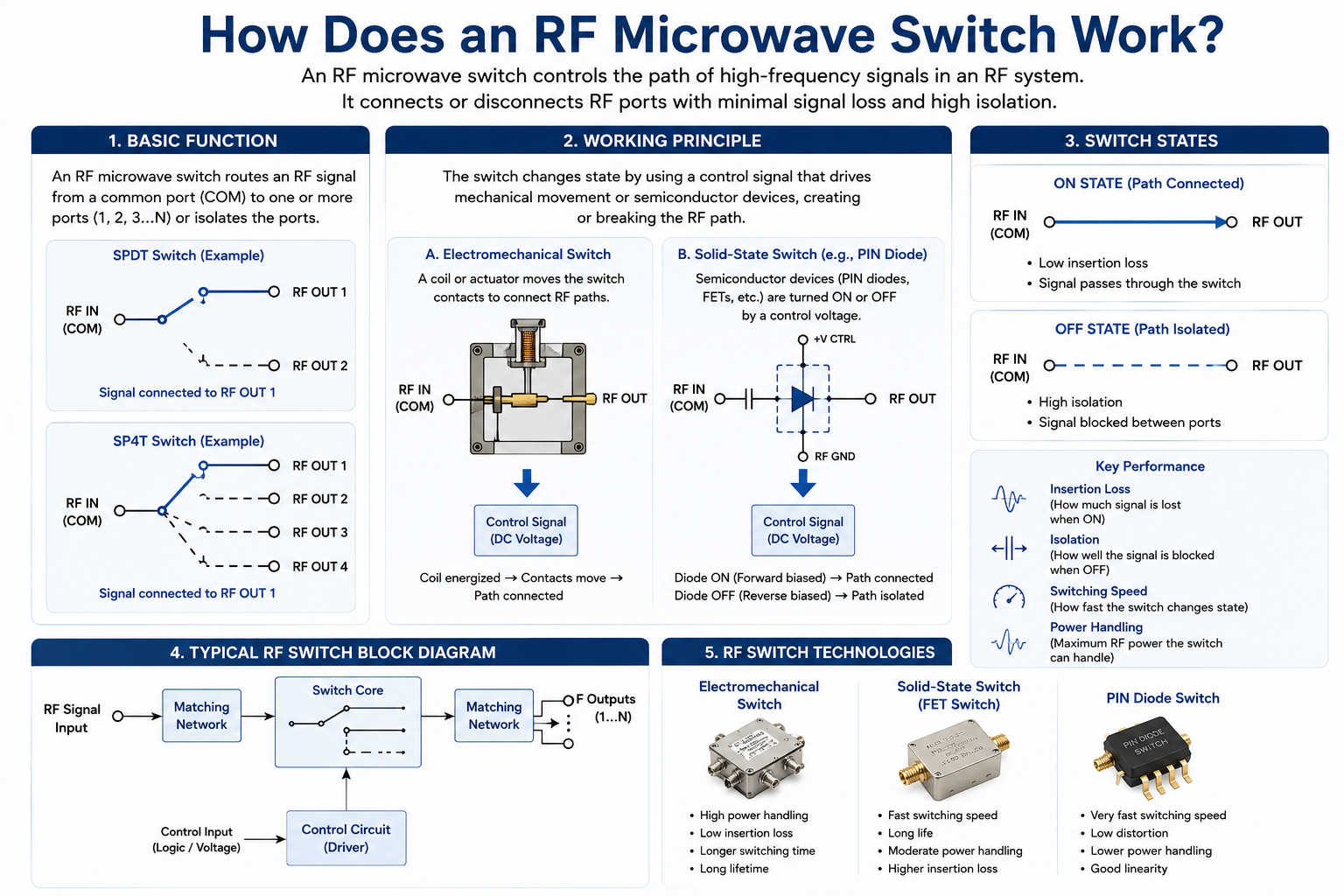
The operating principle varies depending on the switch type, but the fundamental goal remains the same: redirect RF signals with minimal degradation.
Electromechanical Operation
When voltage is applied to the relay coil, it creates a magnetic field that moves a metallic contact arm. This arm physically connects the common port to one of the selected ports. The movement happens in milliseconds, and the spring mechanism returns the arm to its default position when power is removed.
Solid-State Operation
Solid-state switches use semiconductor devices that change their impedance based on control signals:
- Forward-biased PIN diode: Acts as a resistor, allowing signal passage
- Reverse-biased PIN diode: Acts as an open circuit, blocking signals
- FET transistor: Gate voltage controls channel conductivity
Control Methods
RF switches can be controlled through various methods:
- Latching: Maintains state without power, uses magnetic hold
- Non-latching: Returns to default position when power is removed
- Fail-safe: Default position is the common-to-through path
- Digital control: TTL/CMOS logic signals for automated systems
Key Specifications to Consider
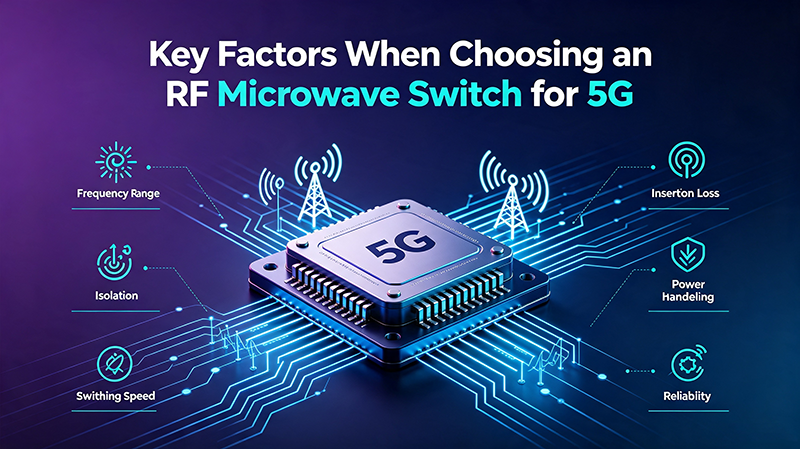
When selecting an RF microwave switch, these specifications are critical:
| Parameter | Description | Typical Range |
|---|---|---|
| Frequency Range | Operating frequency bandwidth | DC to 110 GHz |
| Insertion Loss | Signal power loss when in through path | 0.2 dB to 2.0 dB |
| Isolation | Signal attenuation to off-ports | 40 dB to 100 dB |
| VSWR | Voltage Standing Wave Ratio | 1.1:1 to 1.5:1 |
| Switching Speed | Time to change state | 10 µs to 50 ms |
| Power Handling | Maximum signal power | 0.5 W to 1000 W |
| Impedance | Characteristic impedance | 50 Ω or 75 Ω |
Common Applications
RF microwave switches are used across numerous industries and applications:
Telecommunications
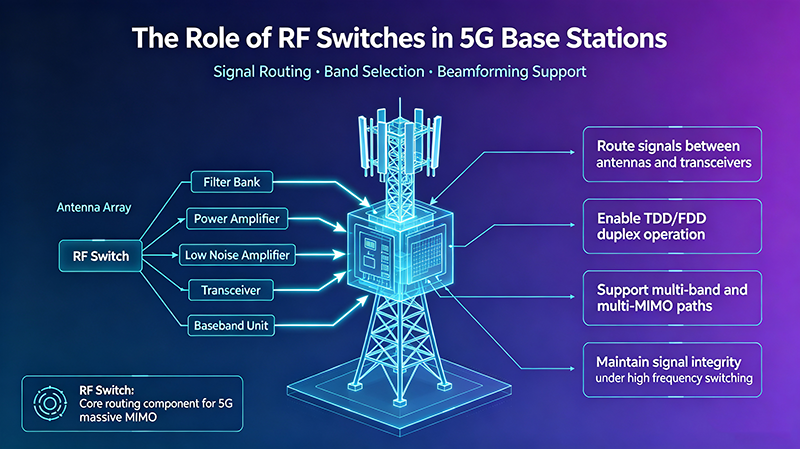
In cellular networks, switches enable antenna diversity, signal routing between transceivers, and failover systems. They help optimize network coverage and reliability.
Test and Measurement
Automated test equipment uses RF switches to connect multiple devices under test (DUT) to a single measurement instrument, reducing equipment costs and increasing testing efficiency.
Radar Systems
Weather radar, air traffic control, and military radar systems rely on switches for antenna selection, signal routing, and system redundancy.
Satellite Communications
Ground stations and satellite payloads use switches for signal routing, redundancy switching, and beam steering applications.
Aerospace and Defense
Electronic warfare systems, communication jammers, and military radios require high-reliability switches that can withstand harsh environments.
How to Choose the Right RF Microwave Switch
Selecting the appropriate switch requires balancing multiple factors:
- Frequency requirements: Match the switch frequency range to your signal frequencies
- Power levels: Ensure the switch can handle your peak and average power
- Switching speed: Consider whether you need latching or non-latching operation
- Isolation needs: Higher isolation reduces cross-talk in multi-channel systems
- Life cycle: Solid-state offers millions of cycles; electromechanical varies
- Environmental factors: Temperature range, vibration, humidity requirements
- Form factor: Consider available space and mounting requirements
Need Help Selecting the Right Switch?
Our engineering team can help you choose the optimal RF microwave switch for your specific application requirements.
Contact Our ExpertsFrequently Asked Questions
Conclusion
RF microwave switches are essential components in modern wireless and microwave systems. Understanding the differences between electromechanical and solid-state switches, along with key specifications like insertion loss, isolation, and switching speed, will help you make informed decisions for your applications.
Whether you need high-power handling for radar systems, fast switching for telecommunications, or reliable performance in aerospace applications, there's an RF microwave switch designed to meet your specific requirements.