


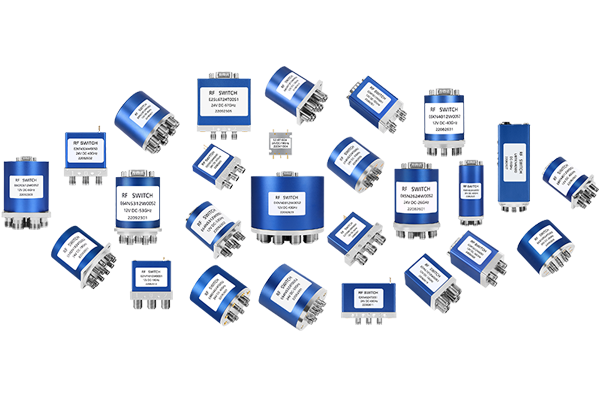
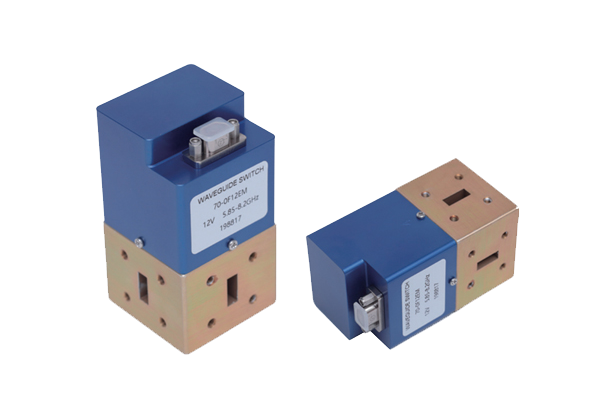
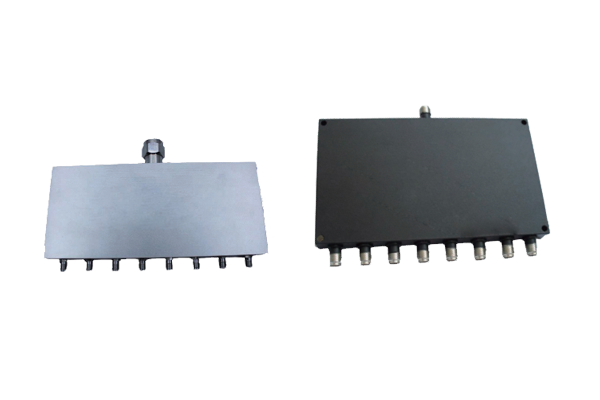
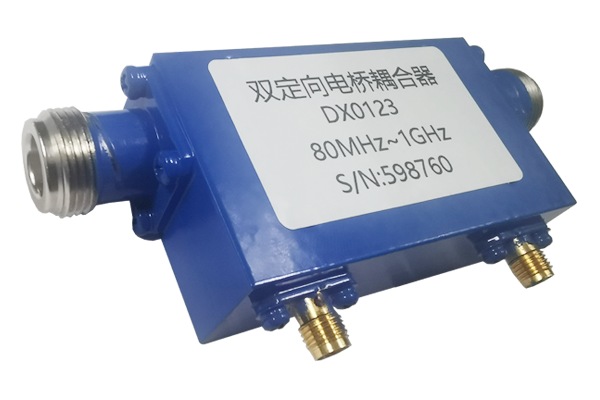
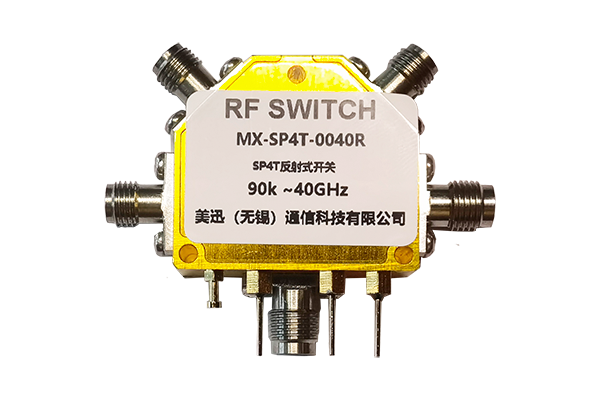




RF microwave switches serve as critical components in 5G base stations and test systems, enabling the high-speed signal routing required for modern wireless networks. From massive MIMO antenna arrays to automated production test equipment, these switches enable the flexibility, performance, and reliability that 5G networks demand. This comprehensive guide explores their roles, applications, and design considerations in next-generation wireless systems.
Introduction and Market Context
The global rollout of 5G networks has created unprecedented demand for high-performance RF microwave switches. These components serve critical functions in both base station infrastructure and test equipment, where they enable the complex signal routing required for modern wireless systems.
5G networks operate across two main frequency ranges: sub-6 GHz (FR1) for broad coverage and mmWave frequencies (FR2, 24-52 GHz) for high-capacity hotspots. Each frequency band places unique demands on switch technology, requiring careful selection based on frequency range, power handling, switching speed, and reliability requirements.
The market for RF switches in 5G applications is experiencing rapid growth, driven by expanding 5G deployments, increasing test complexity, and the evolution toward 6G research. Understanding switch roles and capabilities is essential for RF engineers designing 5G systems.
The Role of RF Switches in 5G Base Stations
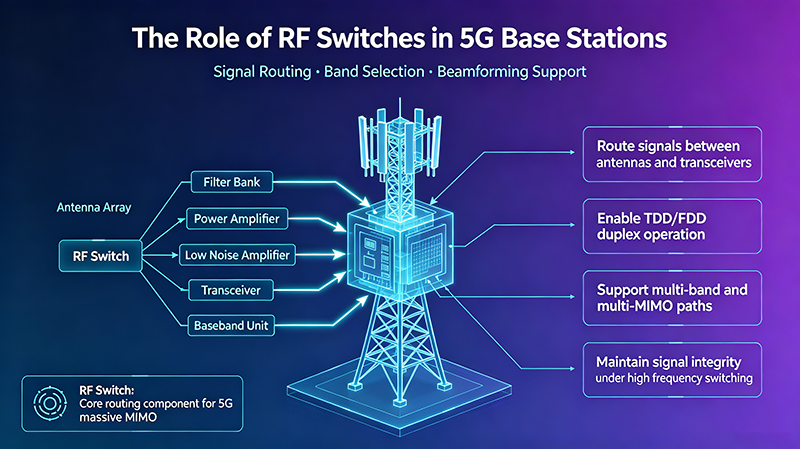
5G base stations employ RF microwave switches in numerous critical functions, from antenna beamforming to redundancy switching. These switches enable the sophisticated signal routing that makes 5G performance possible.
Key Functions in 5G Base Stations
Massive MIMO Systems
- 64T64R or 128T128R antenna arrays
- Per-element T/R switching
- Beamforming signal routing
- Sub-microsecond switching required
TDD Operation
- Time division duplex switching
- Rapid TX/RX transitions
- PIN diode switches preferred
- Nanosecond switching speed
Carrier Aggregation
- Multi-band signal routing
- Filter bank switching
- Antenna path selection
- Multi-throw configurations
Redundancy Systems
- Primary/backup switching
- Hot standby protection
- Latching switch technology
- Reliability critical applications
5G Base Station Switch Requirements
| Parameter | Sub-6 GHz | mmWave (24-40 GHz) | Considerations |
|---|---|---|---|
| Switching Speed | < 1 µs | < 100 ns | PIN diode preferred |
| Insertion Loss | < 0.5 dB | < 1.0 dB | Direct NF impact |
| Isolation | > 40 dB | > 30 dB | Protection critical |
| Power Handling | 10-50 W | 1-10 W | PA output levels |
| Lifetime | > 10^9 cycles | > 10^9 cycles | 5G operation |
The Role of RF Switches in Test Systems
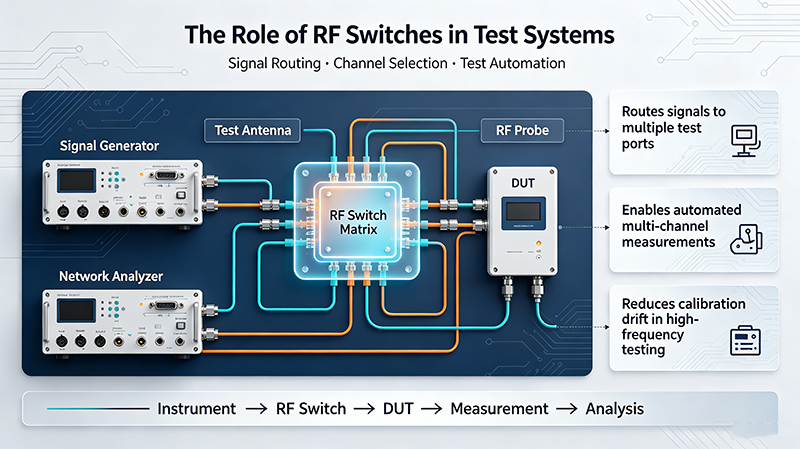
Test and measurement systems rely on RF microwave switches for signal routing, multi-port measurements, and automated test sequences. These switches enable comprehensive testing while reducing test time and cost.
Test System Applications
- Multi-Port Network Analysis: Switch matrices connect multiple DUTs to a single VNA, dramatically reducing test time
- Automated Production Test: Switch-based test systems enable hands-free testing of thousands of units daily
- Antenna Measurement: Switch networks enable multi-antenna characterization in compact ranges
- Device Characterization: Switch systems route signals for comprehensive device testing across parameters
- Compliance Testing: Switch matrices support various regulatory test configurations
Test System Switch Requirements
Production Test Systems
- High cycle life (>10 million)
- Excellent repeatability (<0.05 dB)
- Fast switching for throughput
- Coaxial connectors (SMA, N-Type)
R&D and Lab Systems
- Wide frequency coverage
- Matrix switching capability
- High isolation
- Flexible configurations
Field Test Equipment
- Portable and rugged
- Battery operation
- Compact size
- Wide temperature range
mmWave Test Systems
- Precision connectors (2.4mm, 1.85mm)
- Excellent VSWR
- Low loss above 26 GHz
- Phase-stable performance
Test System Benefits
Why Switch-Based Test Systems
Switch-based test systems offer compelling advantages over manual testing. A single VNA with a switch matrix can replace multiple instruments, reducing capital costs by 50-70%. Test time reductions of 70-90% are common in production environments. The improved measurement consistency from automated switching also enhances quality control.
Switch Types and Technologies
Different switch technologies serve different roles in 5G and test applications. Understanding their strengths helps in selecting the optimal switch for each use case.
PIN Diode Switches for 5G
PIN diode switches dominate 5G base station applications due to their nanosecond switching speeds, compact size, and excellent RF performance. Their ability to handle high RF power makes them ideal for TDD switching in massive MIMO arrays.
Electromechanical Switches for Test
Electromechanical coaxial switches are the workhorses of test systems. Their high isolation, low insertion loss, and excellent repeatability make them the preferred choice for multi-port test configurations and production test equipment.
Technology Selection Guide
| Technology | Best For | Frequency | Speed | Key Strength |
|---|---|---|---|---|
| PIN Diode | 5G base stations | Up to 40 GHz | < 1 µs | Fast switching, compact |
| GaAs FET | 5G mobile, integrated | Up to 50 GHz | < 100 ns | IC integration |
| Electromechanical | Test systems | DC to 67 GHz | 5-15 ms | High isolation |
| RF MEMS | Premium test | DC to 100 GHz | 1-10 µs | Ultra-low loss |
| Matrix Switches | Multi-port test | DC to 50 GHz | 10-50 ms | Multiple path options |
Design Considerations
Successful RF switch integration in 5G and test applications requires careful attention to multiple design factors. These considerations affect performance, reliability, and system cost.
For 5G Base Station Design
- Switching Speed: Must support TDD timing requirements (typically < 1 µs for sub-6 GHz)
- Power Handling: Must accommodate PA output levels with safety margin
- Insertion Loss: Directly impacts system noise figure and EIRP
- Isolation: Prevents receiver desensitization from transmit signals
- Reliability: Must support 10+ year operational life with billions of switching cycles
- Power Consumption: Critical for energy efficiency in dense deployments
- Size: Compact packages for dense antenna arrays
- Thermal Management: Adequate cooling for sustained operation
For Test System Design
- Repeatability: Consistent performance across millions of switching cycles
- Switching Speed: Balance against isolation and power handling
- Isolation: Critical for accurate measurements
- VSWR: Low reflection for measurement accuracy
- Connector Type: Match to test equipment interfaces
- Control Interface: Compatibility with test software
- Lifetime: Sufficient for production test volumes
Key Applications
5G Base Station Antennas
Massive MIMO antennas use RF switches for per-element T/R switching and beamforming control. Switch performance directly determines beam quality and system coverage.
mmWave 5G Systems
24-40 GHz switches enable signal routing in mmWave base stations and user equipment. High-frequency performance is critical for 5G FR2 operation.
Network Analyzers
Multi-port VNAs use switch matrices for automated multi-port measurements. Switch repeatability directly impacts measurement accuracy.
Production Test Systems
Cell phone and IoT device testing relies on switch matrices for high-volume, automated testing. Cycle life and speed are critical.
Automated Test Equipment (ATE)
ATE systems use switches for flexible test configurations. Fast switching enables high throughput in manufacturing test environments.
Compliance Testing
Regulatory compliance tests for 5G devices require precise, repeatable signal routing through switch matrices.
Base Station Manufacturing
5G base station production testing uses switch systems for calibration, verification, and quality assurance.
Field Test Equipment
Portable 5G test sets use rugged switches for network deployment verification and field maintenance.
Future Trends and Developments
The RF microwave switch industry continues to evolve rapidly, driven by 5G expansion, 6G research, and emerging test requirements.
Emerging Trends
- Higher Integration: Switch ICs with integrated bias control, digital interfaces, and protection circuits
- mmWave Expansion: Growing demand for 24-40 GHz and higher frequency switches
- AI-Optimized Designs: Machine learning tools for switch design optimization
- GaN Technology: GaN switches for high-power 5G applications
- Energy Efficiency: Lower power consumption for sustainable 5G deployments
- 6G Research: Sub-THz switch development for next-generation wireless
- Software-Defined Switches: Programmable switches for adaptive systems
- Digital Control: SPI/I2C controlled switches with diagnostic capabilities
Industry Outlook
The RF microwave switch market for 5G applications is expected to continue strong growth through 2030, driven by global 5G deployment, increasing test complexity, and the development of 6G technologies. Switch manufacturers investing in advanced technologies like GaN, integrated modules, and digital control will lead the industry.
Frequently Asked Questions
Conclusion
RF microwave switches play indispensable roles in both 5G base stations and test systems. In 5G infrastructure, they enable the fast switching, beamforming, and signal routing that make massive MIMO and TDD operation possible. In test systems, they provide the flexibility, automation, and measurement consistency required for modern RF testing.
Understanding the distinct requirements of each application, including frequency range, switching speed, power handling, isolation, and lifetime, is essential for optimal switch selection. PIN diode switches dominate 5G base stations, while electromechanical switches remain the standard for test applications.
As 5G networks continue to expand globally and 6G research advances, the demand for high-performance RF microwave switches will continue growing. Manufacturers investing in advanced technologies, integration, and quality will lead the industry in serving these critical applications.
Looking for High-Performance RF Switches?
Our team provides expert guidance on selecting RF microwave switches for 5G base stations and test systems. Contact us for application engineering support.
Contact Our Technical Team