






High Power Waveguide Switch: Design, Performance, and Applications
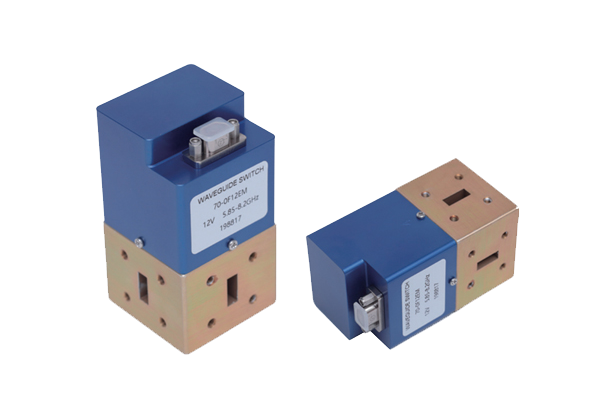
A high power waveguide switch is a critical microwave component designed to control the transmission path of high-frequency signals while handling high RF power levels. These switches are widely used in radar systems, satellite communications, aerospace applications, defense systems, and high-power microwave testing environments.
Compared with conventional coaxial switches, high power waveguide switches provide superior power handling capability, lower insertion loss, and excellent signal integrity at millimeter-wave and microwave frequencies. Selecting the right waveguide switch requires a detailed understanding of power ratings, frequency range, switching speed, isolation, and reliability.
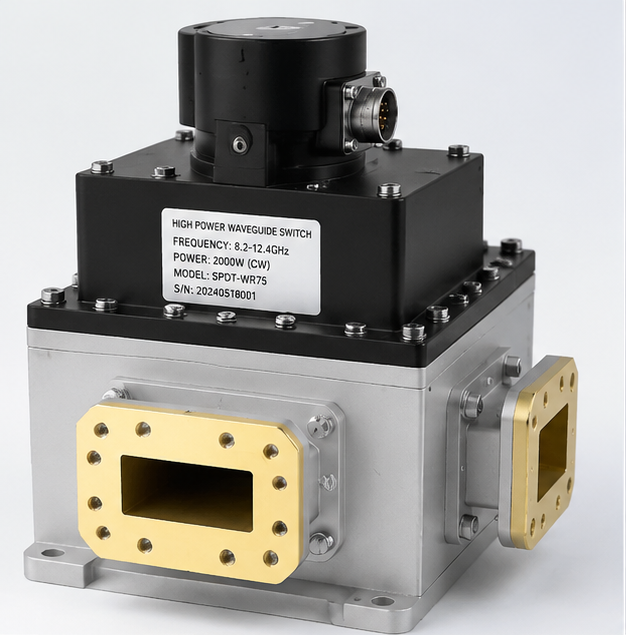
What Is a High Power Waveguide Switch?
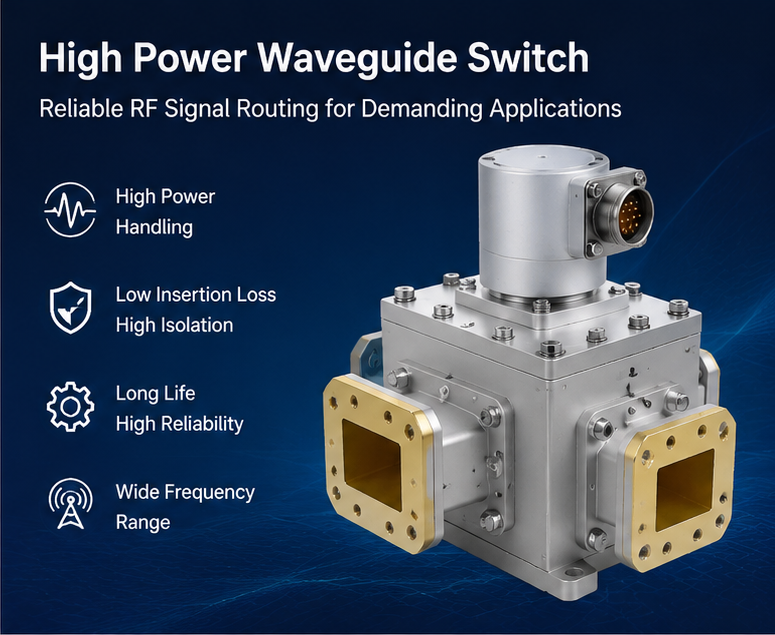
A high power waveguide switch is an electromechanical or electronically controlled device that routes microwave signals between multiple waveguide paths. It allows engineers to connect, disconnect, or redirect RF signals without manually changing physical connections.
Unlike standard microwave switches designed for low or medium power applications, high power waveguide switches are optimized to withstand significant RF energy without signal distortion, arcing, or performance degradation.
How Does a High Power Waveguide Switch Work?
High power waveguide switches operate by mechanically moving a conductive switching element inside the waveguide structure. The switching mechanism changes the electromagnetic path, allowing the RF signal to pass through the selected channel.
Most high power waveguide switches use precision mechanical components driven by motors or actuators. When a control signal is received, the actuator moves the switching assembly into the required position, creating a low-loss RF connection.
Main Operating Process:
- The control system sends a switching command.
- The actuator moves the internal switching mechanism.
- The waveguide path is connected to the selected RF channel.
- The microwave signal continues with minimal insertion loss.
Key Specifications of High Power Waveguide Switches
Engineers must evaluate several important specifications when choosing a high power waveguide switch for demanding microwave applications.
| Specification | Description |
|---|---|
| Frequency Range | The operating frequency capability of the waveguide switch, including X-band, Ku-band, Ka-band, and millimeter-wave frequencies. |
| Power Handling | The maximum RF power level the switch can handle without damage or signal degradation. |
| Insertion Loss | The amount of signal loss introduced when the switch is in the RF path. |
| Isolation | The ability to prevent unwanted signal leakage between switched channels. |
| VSWR | A measurement of impedance matching and reflected power performance. |
| Switching Speed | The time required for the switch to move between different RF paths. |
Advantages of High Power Waveguide Switches
1. Excellent Power Handling Capability
The primary advantage of a high power waveguide switch is its ability to handle large amounts of RF power. The waveguide structure provides efficient energy transmission with reduced heating and power loss.
2. Low Insertion Loss
Waveguide technology offers lower transmission loss compared with many coaxial solutions, especially at higher frequencies. This makes waveguide switches ideal for applications requiring maximum signal efficiency.
3. High Isolation Performance
High isolation prevents interference between different RF channels, improving system accuracy and reliability in complex microwave networks.
4. Long Operating Life
High-quality mechanical waveguide switches are designed for millions of switching cycles, making them suitable for continuous operation in industrial and military environments.
Applications of High Power Waveguide Switches
High power waveguide switches are used in many advanced RF and microwave systems, including:
- Radar Systems: Used for signal routing, antenna selection, and transmitter/receiver switching.
- Satellite Communications: Supports reliable switching in high-frequency communication payloads.
- Aerospace and Defense: Provides high-performance RF control in mission-critical systems.
- RF Testing Equipment: Enables automated microwave measurement systems.
- 5G and Millimeter-Wave Testing: Supports high-frequency test environments.
High Power Waveguide Switch vs Coaxial Switch
| Feature | High Power Waveguide Switch | Coaxial Switch |
|---|---|---|
| Power Handling | Very High | Medium to High |
| Frequency Performance | Excellent at microwave and mmWave frequencies | Excellent for broadband applications |
| Insertion Loss | Very Low | Low |
| Typical Applications | Radar, satellite, defense, high-power testing | RF testing, communication systems |
How to Choose the Right High Power Waveguide Switch
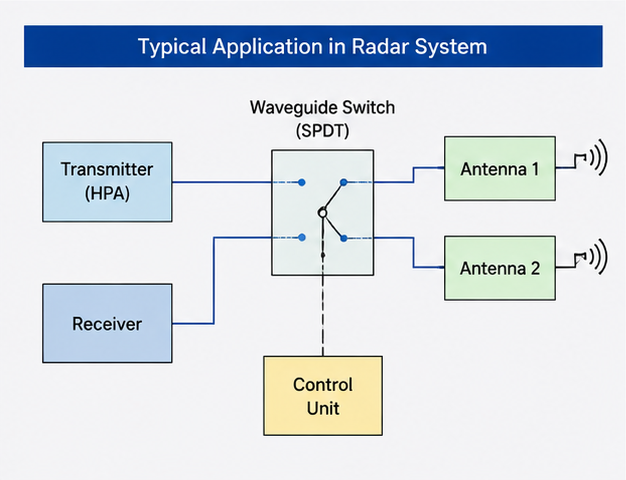
Choosing the correct waveguide switch requires matching the device specifications with the system requirements.
- Determine Frequency Range: Select a switch compatible with the operating band, such as WR-90, WR-42, WR-28, or higher-frequency waveguide standards.
- Check Power Requirements: Ensure the switch supports continuous wave and peak power levels.
- Evaluate RF Performance: Compare insertion loss, VSWR, and isolation values.
- Consider Switching Reliability: Verify switching cycle life and environmental specifications.
- Select a Reliable Manufacturer: Work with experienced RF component suppliers with proven microwave designs.
Why Choose a Professional High Power Waveguide Switch Manufacturer?
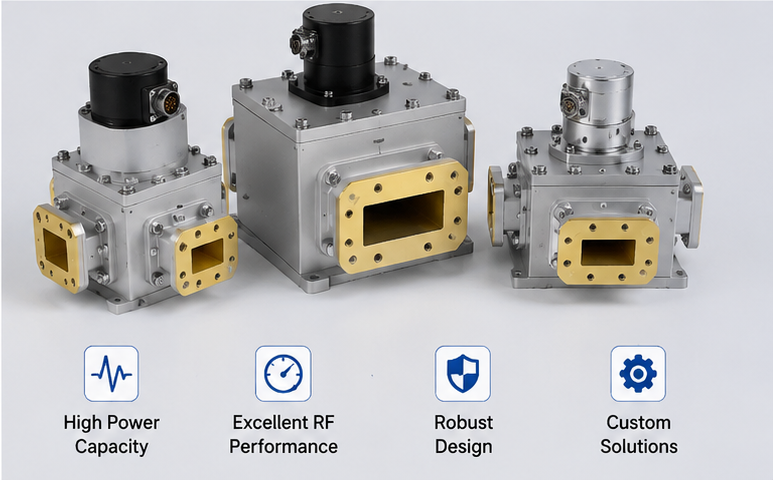
A professional high power waveguide switch manufacturer provides customized solutions based on frequency requirements, power levels, mechanical configurations, and application environments.
Experienced microwave manufacturers can offer optimized designs with excellent RF performance, reliable mechanical structures, and testing support for aerospace, defense, communication, and industrial applications.
Conclusion
High power waveguide switches play an essential role in modern microwave systems where high reliability, low loss, and strong power handling are required. From radar and satellite communication to advanced RF testing platforms, these switches provide accurate signal routing and stable performance at demanding frequencies.
When selecting a high power waveguide switch, engineers should carefully evaluate frequency range, power capability, insertion loss, isolation, and manufacturer expertise to ensure the best system performance.
About the Author — MeiXun Team
Chief Engineer Wang
High-tech Enterprise, Feifeng Talent
Chief Engineer Wang graduated with a master's degree in high-power microwave from the Institute of Electronics, University of Chinese Academy of Sciences.
View Full Profile- RF Switch Circuit Diagram
- RF Switch
- Ohm's Law
- dBm to Watt
- mW to dBm
- Wavelength to Frequency
- RF Connector
- SMA Connector
- RF Switch Module
- RF Coupler
- RF PIN Switch
- Microwave Coaxial Switch
- PIN Switch
- Coaxial RF Switch
- Waveguide Switch
- Microwave Switch
- Low Noise Amplifier
- PIN Diode Switch
- Coaxial Switch
- RF Microwave Switch
- SPST Switch