






How to Choose the Right RF Microwave Switch for 5G Applications
The rapid development of 5G networks has created new challenges for RF system designers. Higher frequencies, wider bandwidth requirements, massive MIMO architectures, and advanced antenna systems require high-performance RF components with excellent reliability and signal integrity. Among these components, the RF microwave switch plays a critical role in controlling signal paths, routing RF channels, and improving system flexibility.
Choosing the right RF microwave switch for 5G applications requires careful consideration of frequency range, insertion loss, isolation, switching speed, power handling capability, and application requirements. This guide explains the key factors engineers should evaluate when selecting an RF microwave switch for modern 5G communication systems.
What Is an RF Microwave Switch?
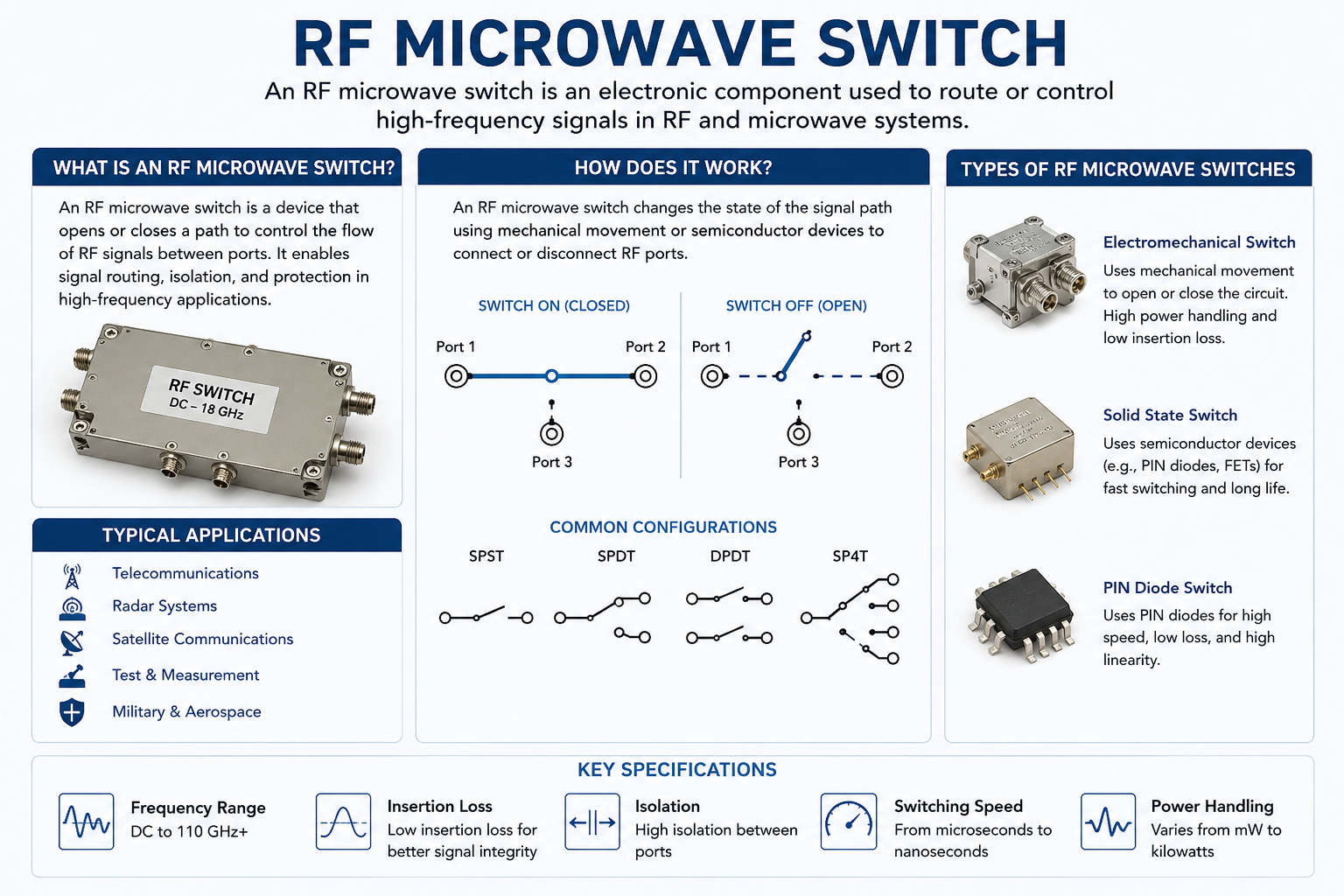
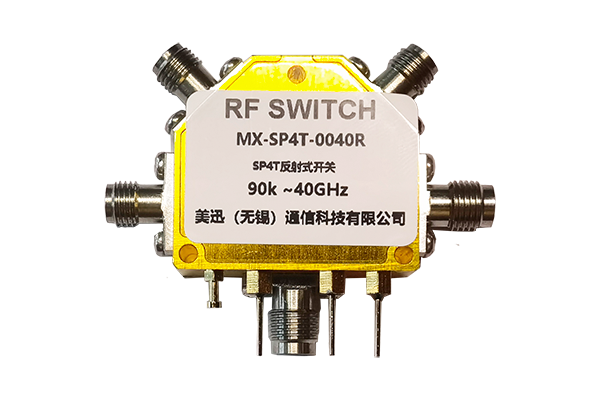
An RF microwave switch is an electronic component used to control the transmission path of radio frequency signals. It allows an RF signal to be connected, disconnected, or redirected between multiple ports while maintaining low signal loss and high isolation.
In 5G infrastructure, RF microwave switches are widely used in base stations, phased array antennas, test equipment, satellite communication systems, and wireless research platforms. They enable dynamic signal routing and support complex RF architectures required by advanced communication networks.
Why RF Microwave Switches Are Important for 5G Systems
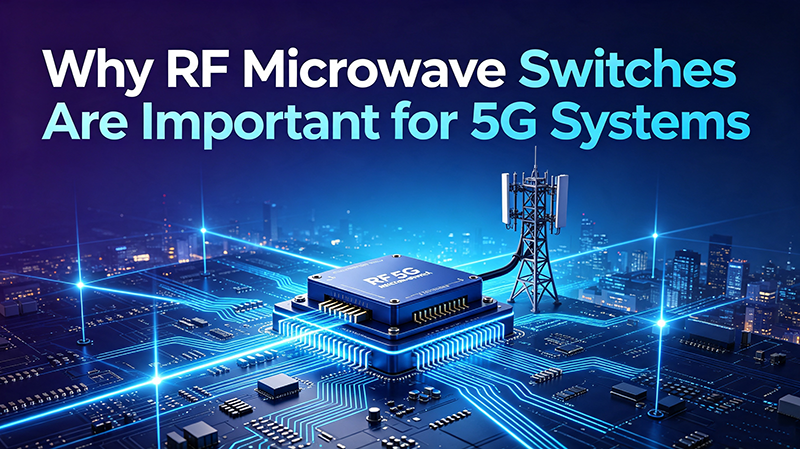
Compared with previous generations of wireless networks, 5G introduces higher frequencies, including sub-6 GHz bands and millimeter-wave frequencies above 24 GHz. These frequencies require RF components with extremely low losses and precise signal control.
- Support multi-band and multi-channel communication systems
- Enable antenna beamforming and beam steering functions
- Improve RF system flexibility and scalability
- Reduce signal degradation in high-frequency applications
- Provide reliable switching performance in demanding environments
Key Factors When Choosing an RF Microwave Switch for 5G
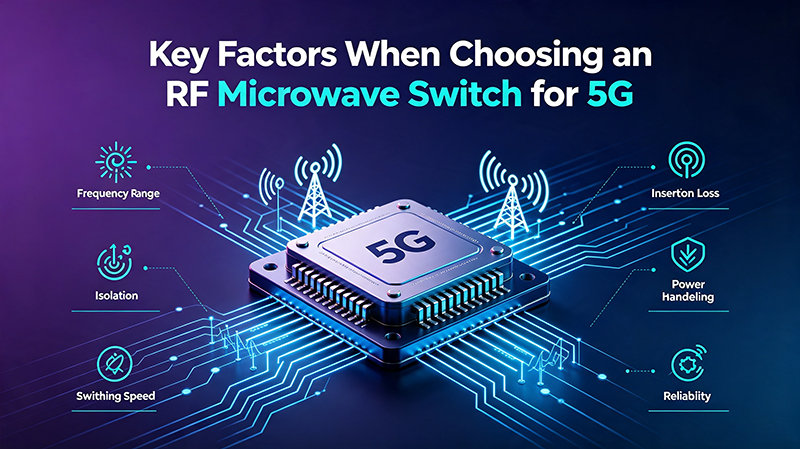
1. Frequency Range and Bandwidth
Frequency capability is one of the most important factors when selecting an RF microwave switch. A switch designed for 5G applications must support the required operating frequency range, including sub-6 GHz and millimeter-wave bands.
For example, 5G systems operating at 28 GHz or 39 GHz require microwave switches with excellent high-frequency performance. Selecting a switch with insufficient bandwidth can result in signal attenuation and reduced system efficiency.
2. Low Insertion Loss
Insertion loss represents the amount of signal power lost when the RF switch is in the ON state. Lower insertion loss means better signal transmission efficiency.
For 5G applications, especially millimeter-wave systems, even small losses can significantly affect coverage, data throughput, and overall network performance.
3. High Isolation Performance
Isolation measures how effectively an RF switch prevents unwanted signals from leaking between inactive ports. High isolation is essential in 5G systems where multiple channels operate simultaneously.
A high-isolation RF microwave switch helps reduce interference, improve signal quality, and maintain reliable communication performance.
4. Switching Speed
Switching speed determines how quickly the RF signal path can change. In 5G networks, fast switching is important for beamforming, antenna switching, and dynamic channel allocation.
PIN diode switches and solid-state RF switches generally provide faster switching speeds than traditional electromechanical switches.
5. Power Handling Capability
The RF switch must handle the expected signal power without distortion or damage. Base stations and transmit systems often require switches with higher power ratings compared with laboratory testing equipment.
Engineers should evaluate both continuous wave (CW) power handling and peak power capability before selecting a switch.
Types of RF Microwave Switches Used in 5G Applications
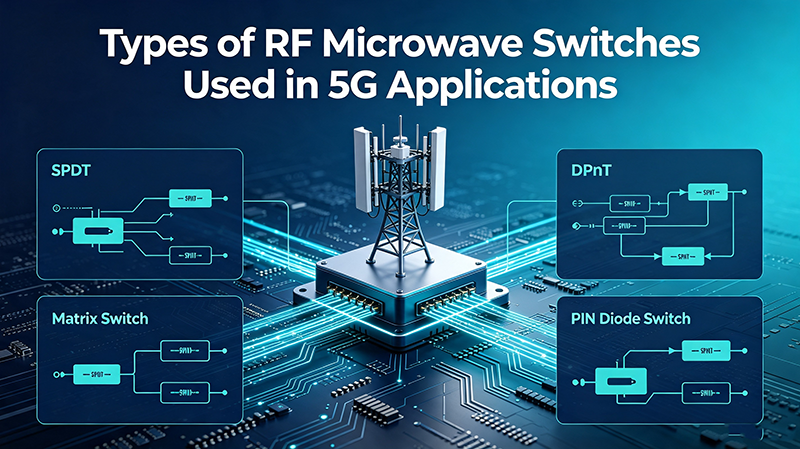
| Switch Type | Advantages | Typical Applications |
|---|---|---|
| Electromechanical RF Switch | High isolation, excellent power handling, low insertion loss | RF testing, communication systems |
| PIN Diode Switch | Fast switching speed, compact design | 5G antennas, phased arrays, wireless systems |
| Solid-State RF Switch | High reliability, long lifetime | Modern RF front-end modules |
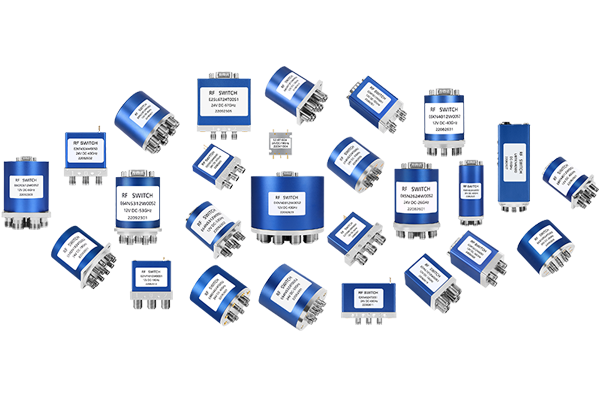
| Coaxial RF Switch | Wide frequency range and excellent RF performance | Test systems and measurement equipment |
RF Microwave Switch Applications in 5G Networks
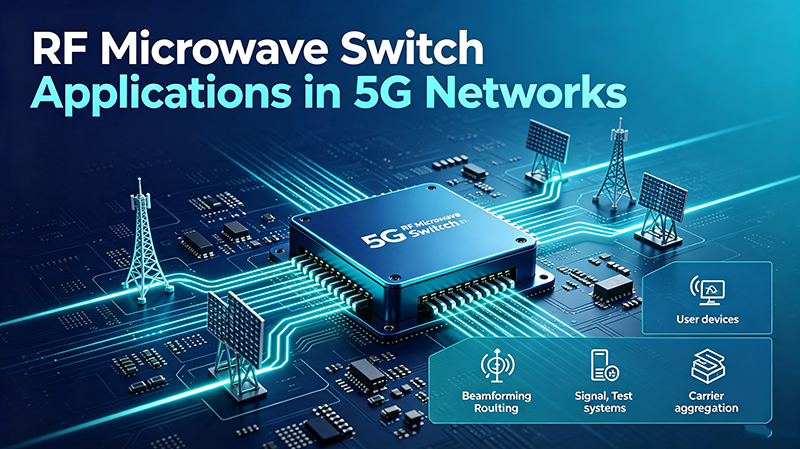
5G Base Stations
RF microwave switches are used in base stations to manage multiple RF channels and antenna paths. They support flexible signal routing and improve network capacity.
Massive MIMO and Beamforming Systems
Massive MIMO technology relies on precise antenna control. RF switches enable rapid switching between antenna elements to optimize signal direction and coverage.
5G Testing and Measurement Equipment
RF test systems require reliable switching solutions to connect multiple devices under test. High-performance coaxial switches are commonly used in automated test environments.
Common Mistakes When Selecting an RF Switch
- Choosing a switch without considering the complete frequency range
- Ignoring insertion loss at high frequencies
- Selecting insufficient isolation performance
- Overlooking power handling requirements
- Using a switch that cannot withstand environmental conditions
How to Select the Best RF Microwave Switch Supplier
A reliable RF microwave switch manufacturer should provide products with verified RF performance, accurate specifications, and customization capabilities.
- Wide frequency coverage for 5G and microwave applications
- Low insertion loss and high isolation performance
- Professional RF engineering support
- Custom designs for specific system requirements
- Quality testing and reliable production capability
Conclusion
Selecting the right RF microwave switch for 5G applications requires a comprehensive understanding of frequency requirements, insertion loss, isolation, switching speed, and power handling capability. As 5G networks continue to evolve toward higher frequencies and more complex architectures, high-performance RF switches will remain essential components for reliable wireless communication.
By evaluating application requirements and choosing a trusted RF microwave switch supplier, engineers can achieve better signal performance, improved system reliability, and optimized 5G network deployment.
About the Author — MeiXun Team
Chief Engineer Wang
High-tech Enterprise, Feifeng Talent
Chief Engineer Wang graduated with a master's degree in high-power microwave from the Institute of Electronics, University of Chinese Academy of Sciences.
View Full Profile- RF Switch Circuit Diagram
- RF Switch
- Ohm's Law
- dBm to Watt
- mW to dBm
- Wavelength to Frequency
- RF Connector
- SMA Connector
- RF Switch Module
- RF Coupler
- RF PIN Switch
- Microwave Coaxial Switch
- PIN Switch
- Coaxial RF Switch
- Waveguide Switch
- Microwave Switch
- Low Noise Amplifier
- PIN Diode Switch
- Coaxial Switch
- RF Microwave Switch
- SPST Switch