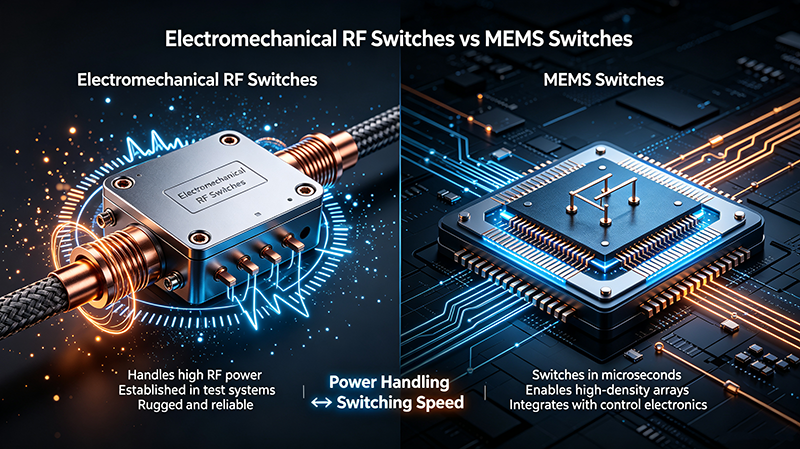


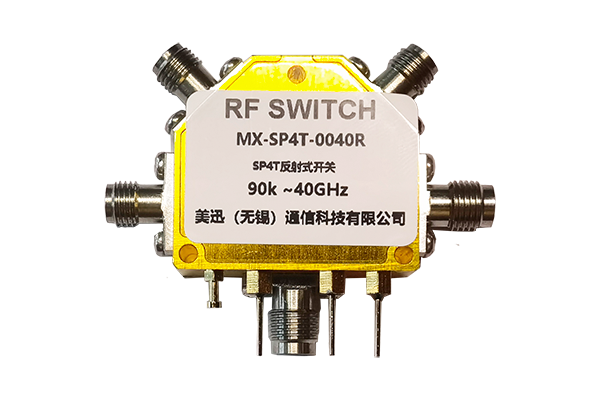
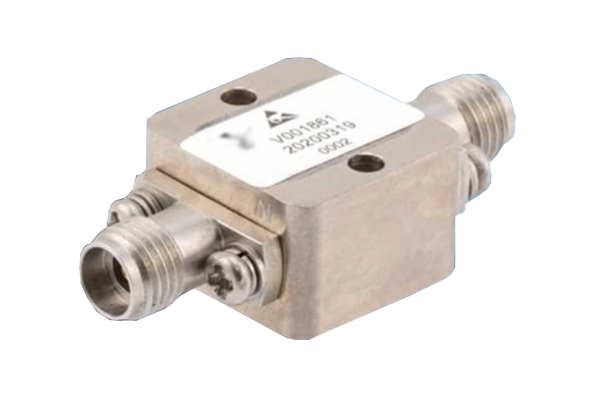
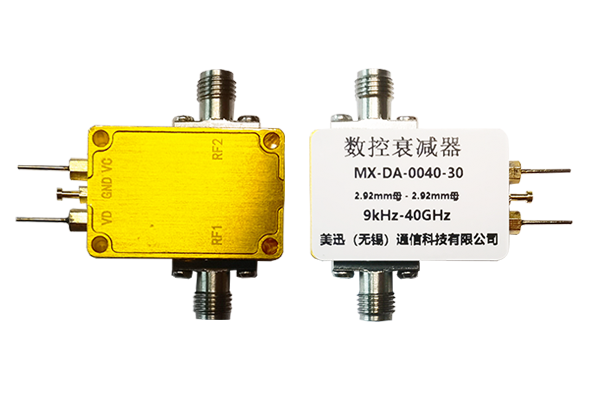
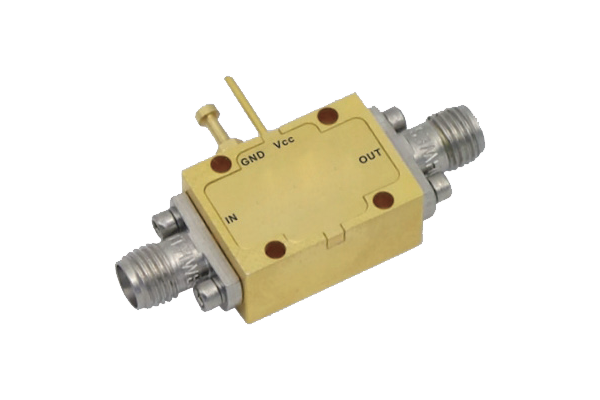
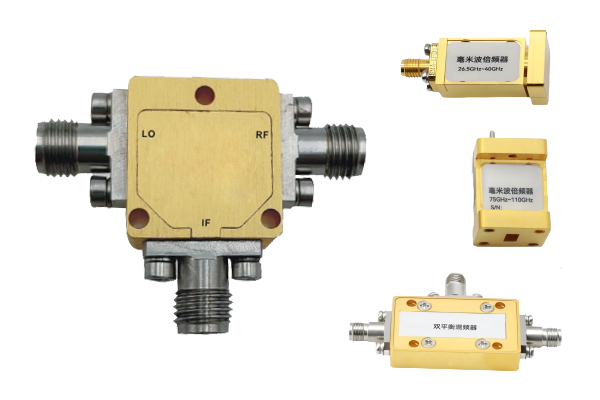




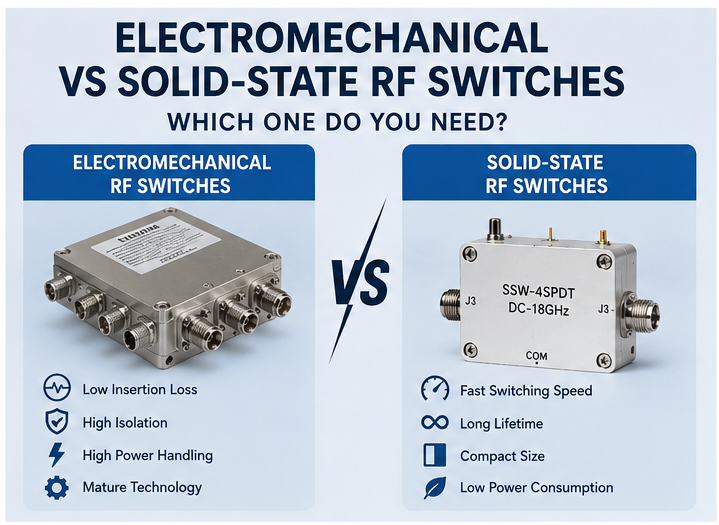
Electromechanical vs Solid-State RF Switches is a common comparison for engineers designing RF, microwave, wireless communication, radar, test and measurement, and electronic warfare systems. Both technologies are used to route high-frequency signals between different RF paths, but they have significant differences in switching speed, insertion loss, isolation, power handling, reliability, and lifetime.
Choosing the right RF switch depends on your system requirements. Electromechanical RF switches are often preferred when excellent isolation, low insertion loss, and high RF power handling are required. Solid-state RF switches, including PIN diode and semiconductor-based solutions, are typically selected when fast switching, high reliability, compact size, and long operational life are critical.
This guide compares electromechanical and solid-state RF switches in detail and explains which technology may be the best fit for your application.
What Is an RF Switch?
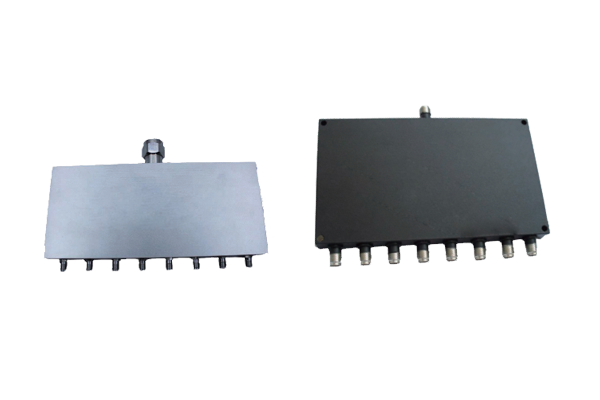
An RF switch is a device used to control the transmission path of radio frequency or microwave signals. Depending on the switch configuration, an RF switch can connect one input to multiple outputs, route multiple inputs to one output, or switch between different signal paths in a complex RF system.
RF switches are widely used in applications such as:
- Wireless communication systems
- RF and microwave test equipment
- Radar and defense systems
- Satellite communication
- Antenna switching systems
- Automated test systems
- RF signal routing and distribution
- Electronic warfare equipment
- 5G and advanced wireless infrastructure
- Laboratory and production measurement systems
The two major categories discussed in this article are electromechanical RF switches and solid-state RF switches. While both perform the same basic function of RF signal routing, their internal technologies are fundamentally different.
What Are Electromechanical RF Switches?
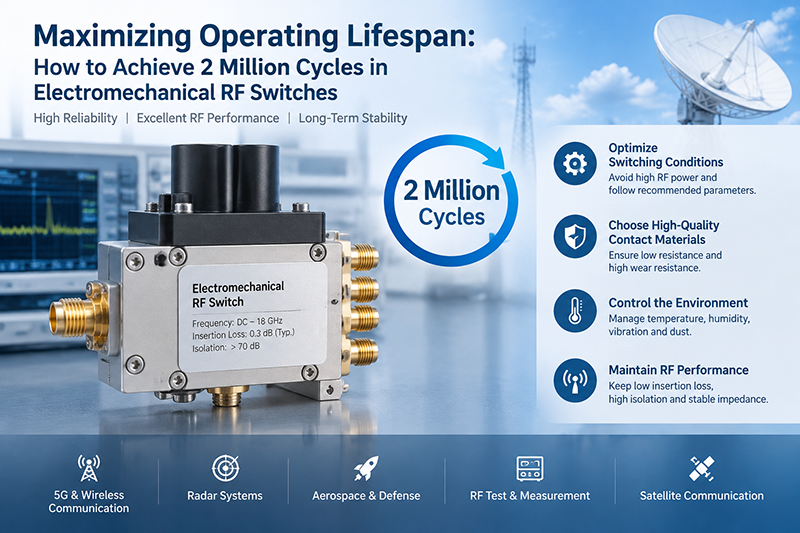
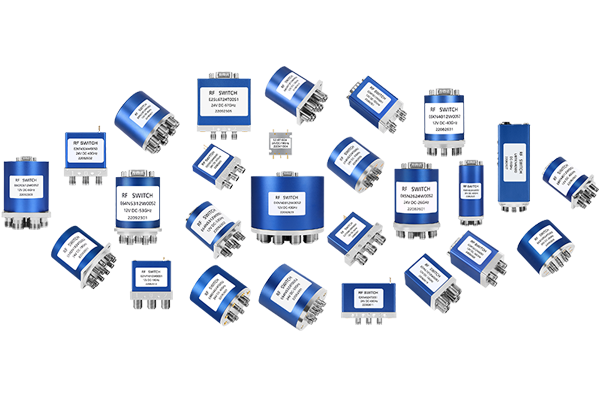
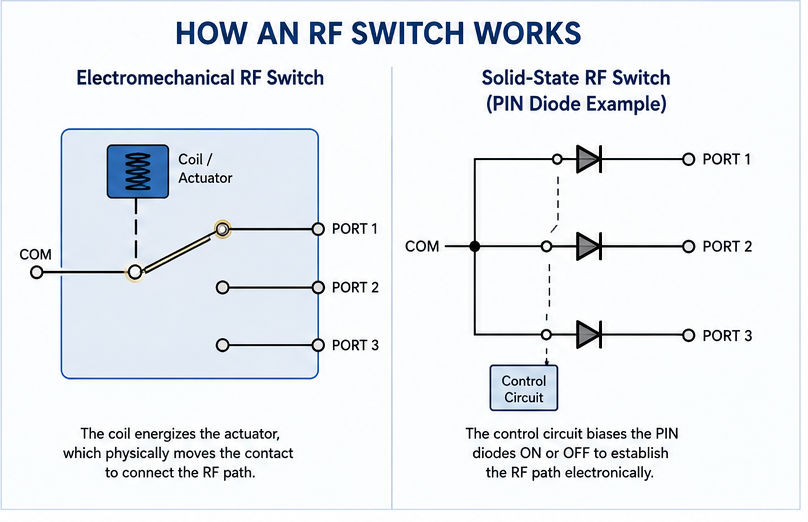
Electromechanical RF switches use physical mechanical contacts to connect or disconnect RF signal paths. An actuator, typically driven by a DC coil or motor, physically moves the switching mechanism to establish the desired electrical connection.
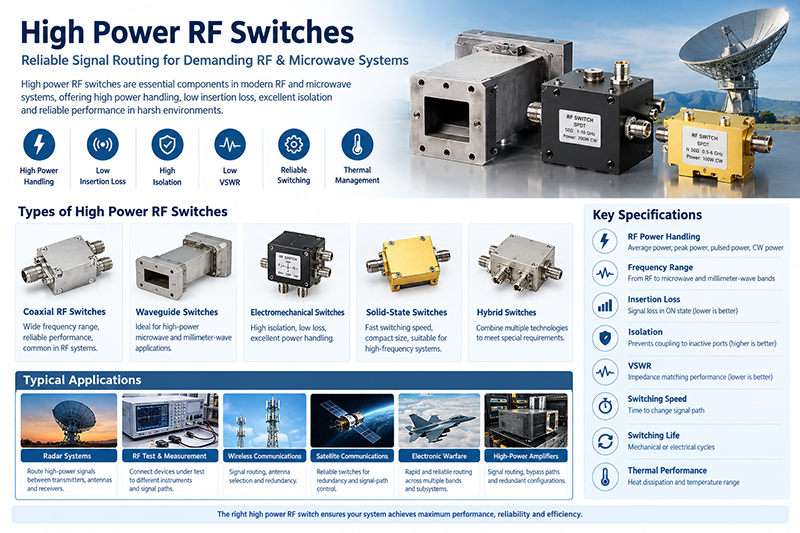
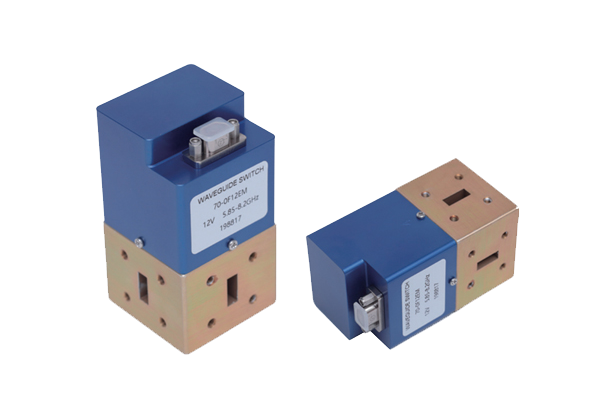
Common electromechanical RF switch types include coaxial switches, waveguide switches, and relay-based RF switching devices. Coaxial RF switches are particularly common in test and measurement applications because they can provide excellent RF performance across a wide frequency range.
When the switch changes state, a physical contact moves from one position to another. This mechanical action provides a direct electrical connection with very low signal loss and high isolation between inactive ports.
Advantages of Electromechanical RF Switches
- Low insertion loss: Direct physical connections can provide very low RF signal attenuation.
- High isolation: Mechanical separation between RF paths can provide excellent isolation.
- High power handling: Many electromechanical switches can handle significantly higher RF power than small semiconductor switches.
- Broad frequency coverage: Coaxial and waveguide configurations can support a wide range of RF and microwave frequencies.
- Excellent linearity: Passive mechanical contacts generally produce very low distortion.
- Low off-state leakage: The physical disconnection of RF paths can minimize unwanted signal coupling.
Disadvantages of Electromechanical RF Switches
- Slower switching speed: Mechanical movement is inherently slower than semiconductor switching.
- Limited mechanical lifetime: Contacts and moving components eventually wear out.
- Larger physical size: High-performance mechanical switches may require more space.
- Higher power consumption during switching: The actuator or coil may require additional power.
- Mechanical noise: Physical movement can generate audible clicking or vibration.
- Higher maintenance requirements: Applications with extremely high switching cycles may require more frequent replacement.
What Are Solid-State RF Switches?
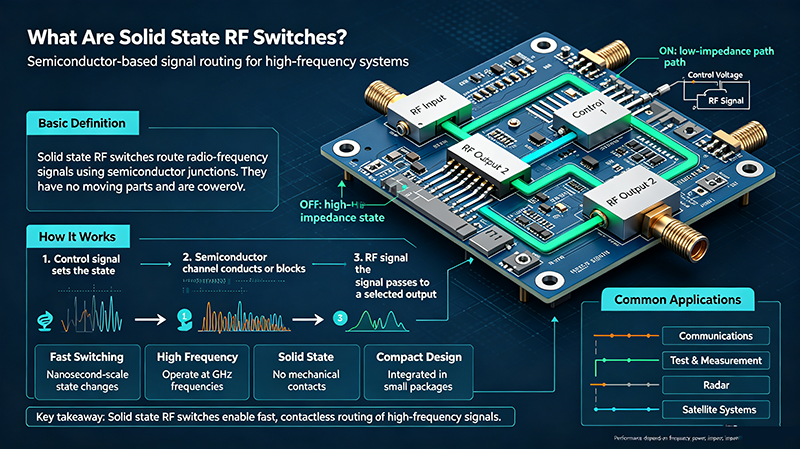
Solid-state RF switches use semiconductor devices rather than moving mechanical contacts. Common technologies include PIN diode switches, FET-based switches, SOI devices, CMOS RF switches, and other semiconductor technologies.
A solid-state RF switch changes its electrical state by controlling semiconductor conduction. Because there are no moving components, the switch can operate extremely quickly and can withstand very large numbers of switching cycles.
Solid-state RF switches are widely used in applications where speed, compact size, reliability, and high switching frequency are more important than extremely low insertion loss or maximum RF power handling.
Advantages of Solid-State RF Switches
- Very fast switching: Semiconductor devices can switch in microseconds, nanoseconds, or even faster depending on the technology.
- Long operational life: The absence of mechanical contacts eliminates mechanical wear.
- High switching cycle capability: Solid-state devices can support extremely frequent switching.
- Compact size: Semiconductor-based designs can be highly integrated and space-efficient.
- Low power consumption: Many solid-state RF switches require relatively low control power.
- Silent operation: There are no mechanical movements or audible switching sounds.
- High reliability: The lack of moving parts makes solid-state switches suitable for demanding continuous-operation environments.
Disadvantages of Solid-State RF Switches
- Higher insertion loss: Semiconductor devices may introduce more loss than direct mechanical connections.
- Lower isolation in some configurations: Unwanted RF coupling may be higher depending on the device and frequency.
- Limited power handling: Semiconductor RF switches may have lower maximum power ratings than mechanical switches.
- Nonlinear behavior: Some semiconductor technologies may generate harmonics or intermodulation products.
- Temperature sensitivity: Electrical characteristics can change with temperature.
- Bias requirements: Some solid-state switch architectures require carefully designed control and bias circuits.
Electromechanical vs Solid-State RF Switches: Key Differences
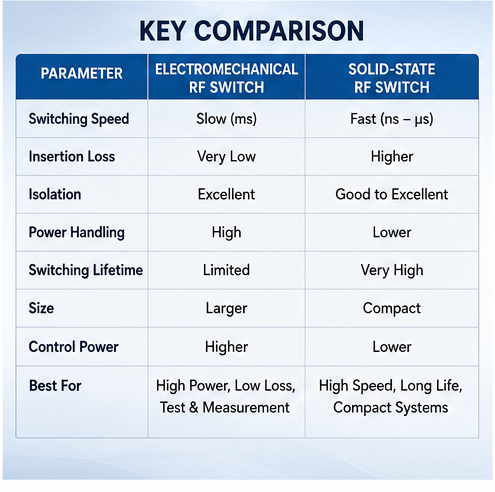
The best RF switch technology depends on the balance between electrical performance, switching speed, mechanical reliability, power handling, and system cost.
| Performance Factor | Electromechanical RF Switch | Solid-State RF Switch |
|---|---|---|
| Switching Speed | Typically slower due to mechanical movement | Very fast, often suitable for high-speed switching |
| Insertion Loss | Typically very low | Generally higher than mechanical alternatives |
| Isolation | Typically excellent | Good to excellent depending on design and frequency |
| Power Handling | Often high | Generally lower, depending on semiconductor technology |
| Switching Lifetime | Limited by mechanical wear | Extremely high because there are no moving parts |
| Physical Size | Usually larger | Typically smaller and easier to integrate |
| Switching Noise | May produce mechanical noise | Silent |
| Linearity | Typically excellent | Depends on semiconductor technology and operating conditions |
| Control Power | May require actuator or coil power | Often low control power |
| Best Applications | High-power RF, test equipment, low-loss signal routing | Fast switching, high-cycle systems, compact RF equipment |
Switching Speed: Which Technology Is Faster?
If switching speed is the primary design requirement, solid-state RF switches generally have a clear advantage.
Electromechanical switches require physical movement before the RF signal path changes. Depending on the switch design, switching time may range from milliseconds to tens of milliseconds or longer.
Solid-state switches can change state much faster because the switching mechanism is electrical rather than mechanical. PIN diode switches and other semiconductor technologies can achieve switching times suitable for fast RF signal routing, pulse modulation, radar systems, and communication applications.
Choose solid-state RF switches when: Your system requires rapid switching, frequent switching cycles, real-time signal routing, or high-speed RF control.
Insertion Loss and Signal Quality
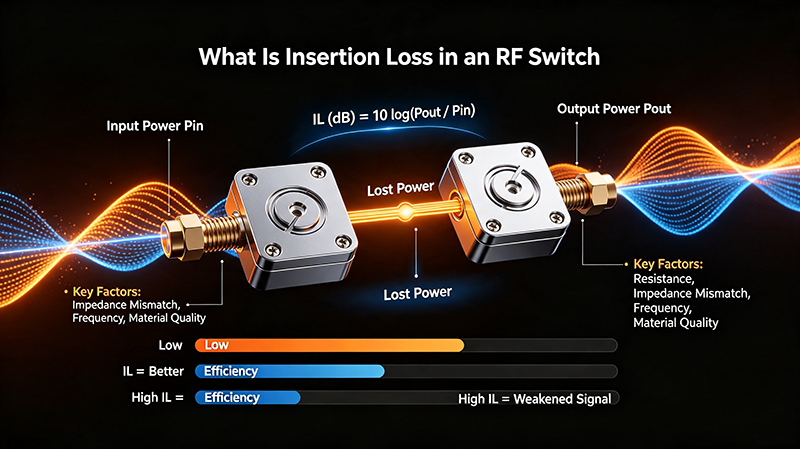
Insertion loss is a critical parameter in RF and microwave systems because every additional dB of loss reduces the available signal power and can negatively affect system sensitivity and link performance.
Electromechanical RF switches often provide very low insertion loss because the active RF path is established through a direct physical connection. This makes them attractive for precision test equipment, measurement systems, and applications where signal integrity is critical.
Solid-state RF switches introduce semiconductor devices into the RF signal path. As a result, insertion loss may be higher, although modern semiconductor technologies continue to improve RF performance.
If your primary goal is minimizing insertion loss, an electromechanical switch may be the better choice. However, the difference should always be evaluated at the specific operating frequency and power level required by your system.
Isolation Performance
Isolation describes how effectively an RF switch prevents unwanted signals from passing through an inactive port or switching path.
High isolation is essential in applications involving sensitive receivers, multi-channel RF systems, radar equipment, and test systems where signal leakage can affect measurement accuracy.
Electromechanical RF switches can provide excellent isolation because the inactive RF path can be physically disconnected. Solid-state RF switches also offer strong isolation, but performance depends heavily on semiconductor architecture, frequency, package design, PCB layout, and the specific switch configuration.
When selecting an RF switch, engineers should compare isolation across the entire operating frequency range rather than relying on a single typical value.
RF Power Handling
Power handling is another major factor when choosing between electromechanical and solid-state RF switches.
Electromechanical switches are often preferred for high-power RF applications. Their physical contacts and robust mechanical construction can handle higher power levels, especially at lower frequencies and in specialized RF and microwave configurations.
Solid-state switches have improved significantly, but semiconductor devices can be limited by voltage, current, thermal performance, and device breakdown characteristics. High RF power can also generate excessive heat and distortion.
For high-power transmit paths, RF test systems, and applications requiring substantial power margins, electromechanical switches are often the preferred solution.
Important: Always verify the switch's maximum input power, average power, peak power, VSWR, frequency range, and temperature conditions. Power handling specifications can vary significantly between different RF switch designs.
Reliability and Switching Lifetime
Reliability requirements can strongly influence the choice between electromechanical and solid-state RF switches.
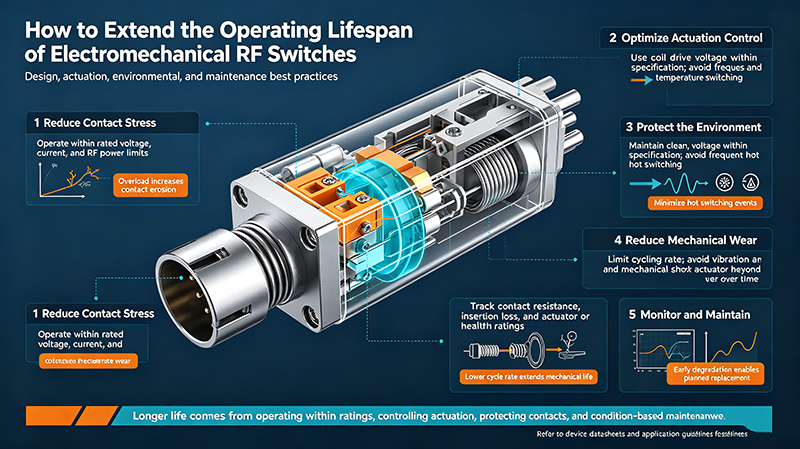
Mechanical switches contain moving components and electrical contacts. Repeated switching can eventually cause contact wear, mechanical fatigue, or actuator degradation. Therefore, the expected switching cycle count should be carefully evaluated during system design.
Solid-state RF switches do not contain moving components. This allows them to operate for extremely large numbers of switching cycles, making them ideal for systems that continuously change RF signal paths.
However, solid-state devices are not immune to failure. Excessive RF power, thermal stress, electrostatic discharge, incorrect bias conditions, and other electrical stresses can affect device reliability.
For systems that switch occasionally, the mechanical lifetime of an electromechanical switch may be more than sufficient. For systems that switch thousands, millions, or billions of times, solid-state technology is often more appropriate.
Which RF Switch Is Better for Test and Measurement?
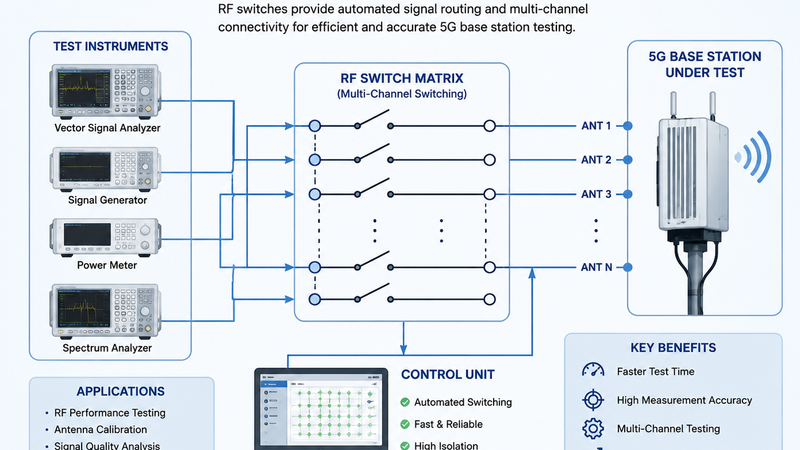
RF and microwave test equipment often requires low insertion loss, excellent isolation, high repeatability, and broad frequency coverage. For these reasons, electromechanical coaxial switches are widely used in automated test systems and RF measurement equipment.
They are particularly useful for switching between signal generators, spectrum analyzers, network analyzers, antennas, and devices under test.
However, solid-state RF switches can be advantageous when the test system requires extremely fast switching or very high switching cycle counts. In some automated production environments, solid-state switching can reduce test time and improve system throughput.
The right choice depends on whether RF performance and isolation or switching speed and cycle life are the dominant requirements.
Which RF Switch Is Better for Radar Applications?
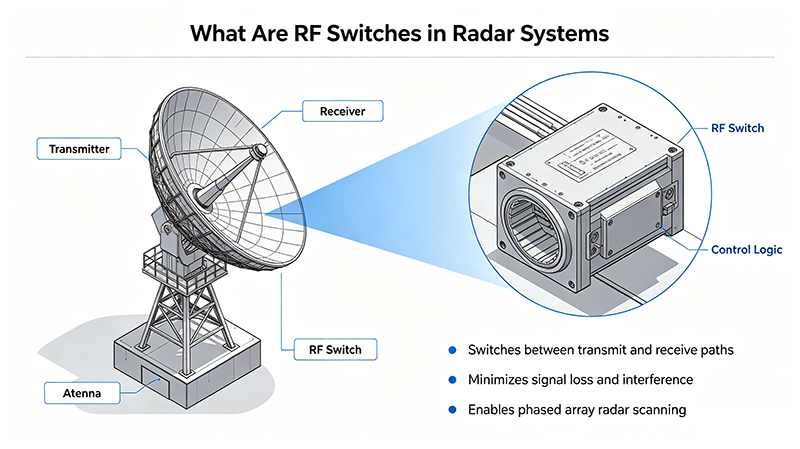
Radar systems often require fast switching, high isolation, high power handling, and excellent reliability. The appropriate technology depends on the radar architecture and operating frequency.
Solid-state RF switches are attractive for fast signal routing and pulse control. PIN diode switches, for example, can provide rapid switching for many RF and microwave applications.
Electromechanical switches may be selected for lower-speed functions, calibration paths, antenna selection, maintenance systems, or applications where low insertion loss and high power handling are more important than switching speed.
Which RF Switch Should You Choose?
There is no single RF switch technology that is best for every application. The correct choice depends on your system's electrical, mechanical, and operational requirements.
Choose an Electromechanical RF Switch If:
- You need very low insertion loss.
- You require high isolation between RF paths.
- Your application involves high RF power.
- Switching speed is not the primary requirement.
- The switch changes state relatively infrequently.
- You need excellent linearity and signal integrity.
- You are designing RF test and measurement equipment.
- You need a robust coaxial or waveguide switching solution.
Choose a Solid-State RF Switch If:
- You require very fast switching.
- Your system switches RF signals frequently.
- You need a long operational lifetime.
- Compact size is important.
- Silent operation is required.
- You need low control power.
- You are designing high-speed communication or radar equipment.
- You need reliable switching without mechanical wear.
Key Parameters to Consider Before Buying an RF Switch
Regardless of whether you choose electromechanical or solid-state technology, several specifications should be evaluated before selecting an RF switch.
- Frequency range: Make sure the switch supports the complete operating frequency band.
- Insertion loss: Lower insertion loss is important for minimizing signal attenuation.
- Isolation: Higher isolation reduces unwanted signal leakage between ports.
- VSWR: A low VSWR helps maintain impedance matching and signal integrity.
- Power handling: Check both average and peak power requirements.
- Switching speed: Select a technology that meets your required switching time.
- Switching lifetime: Consider the expected number of switching cycles.
- Control interface: Verify compatibility with the system's control voltage and communication architecture.
- Operating temperature: Confirm that the switch can operate reliably across the required temperature range.
- Connector type: Consider SMA, N-type, 2.92 mm, 2.4 mm, 1.85 mm, waveguide, or other interfaces based on frequency and application requirements.
- Physical dimensions: Make sure the switch fits within the available system space.
- Reliability requirements: Evaluate environmental conditions, vibration, shock, and expected service life.
Electromechanical vs Solid-State RF Switches: The Bottom Line
When comparing electromechanical vs solid-state RF switches, the best choice depends on your application priorities.
Electromechanical RF switches are an excellent choice when low insertion loss, high isolation, high power handling, and excellent linearity are critical. They are particularly suitable for RF test equipment, microwave instrumentation, antenna systems, and applications where switching occurs relatively infrequently.
Solid-state RF switches are better suited to applications that require extremely fast switching, high switching cycle counts, compact designs, low maintenance, and long operational life. They are widely used in communication systems, radar, wireless infrastructure, and high-speed RF signal routing.
Before selecting an RF switch, engineers should carefully evaluate frequency, insertion loss, isolation, power handling, switching speed, lifetime, reliability, and control requirements. By matching these parameters to the application's actual needs, you can select an RF switch that delivers reliable performance and long-term system value.
Frequently Asked Questions About RF Switches
Are solid-state RF switches faster than electromechanical switches?
Yes. Solid-state RF switches generally provide much faster switching because they do not require physical mechanical movement. This makes them suitable for high-speed RF routing and applications with frequent switching.
Which RF switch has lower insertion loss?
Electromechanical RF switches typically offer lower insertion loss than many solid-state RF switches, particularly when designed for high-performance coaxial or microwave applications.
Which RF switch is better for high-power applications?
Electromechanical RF switches are generally preferred for high-power applications because they can often handle higher RF power levels than semiconductor-based switches.
Which RF switch lasts longer?
Solid-state RF switches generally have a much higher switching cycle life because they have no moving mechanical components. Electromechanical switches have a finite mechanical lifetime determined by their contact and actuator design.
Are PIN diode switches solid-state RF switches?
Yes. PIN diode switches are a type of solid-state RF switch. They use the electrical characteristics of PIN diodes to control RF signal transmission and are commonly used in radar, communication, and microwave systems.
How do I select the right RF switch for my application?
Start by identifying your operating frequency, maximum RF power, required insertion loss, isolation, switching speed, switching frequency, lifetime, connector type, control interface, and environmental conditions. Then compare available electromechanical and solid-state solutions based on these requirements.
Related Keywords: RF switches, RF microwave switches, electromechanical RF switches, solid-state RF switches, coaxial RF switches, PIN diode switches, microwave switches, RF switch comparison, high power RF switch, low insertion loss RF switch, fast switching RF switch, RF signal routing, microwave components.