


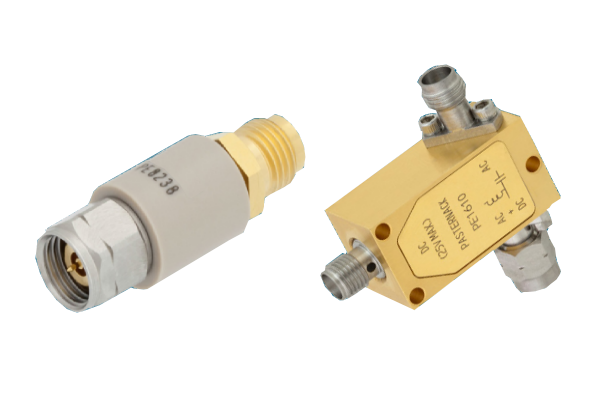
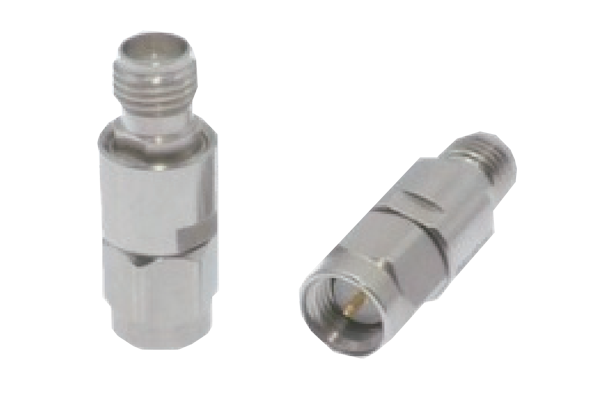
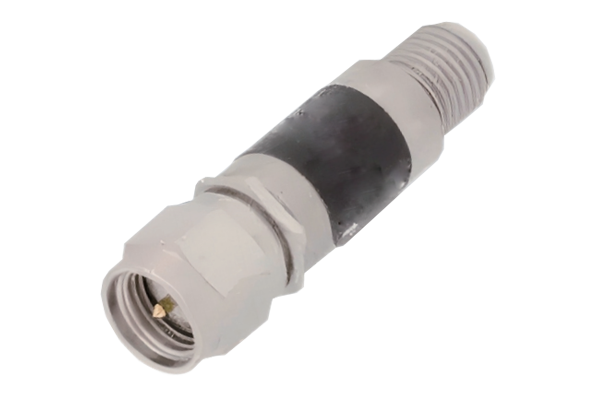
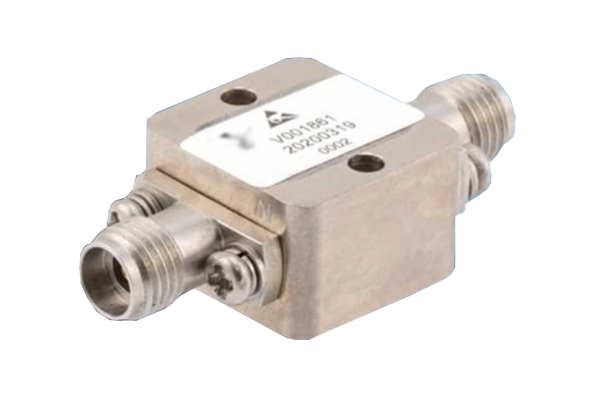
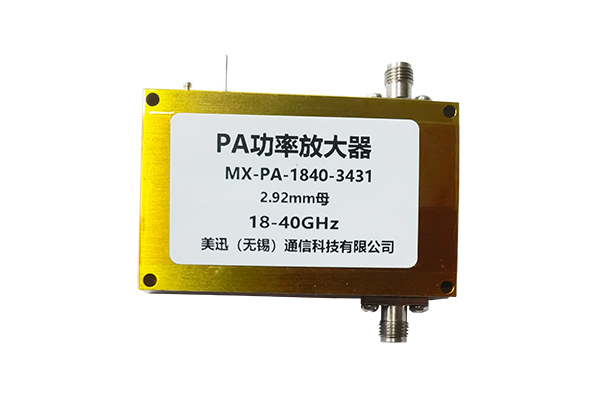
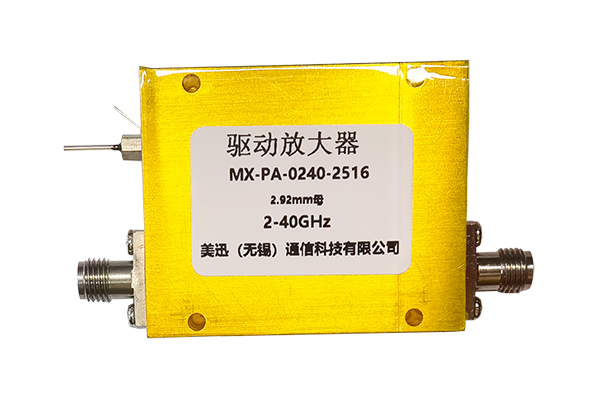




RF attenuators are essential passive components used in radio frequency and microwave systems to reduce signal power while maintaining impedance matching and signal integrity. They play a critical role in communication systems, test equipment, radar applications, satellite systems, and wireless infrastructure.
Among the most common types are fixed attenuators and continuously variable attenuators (CVAs). Understanding the differences between these two solutions helps engineers select the right attenuation technology for specific RF applications.
What Is an RF Attenuator?
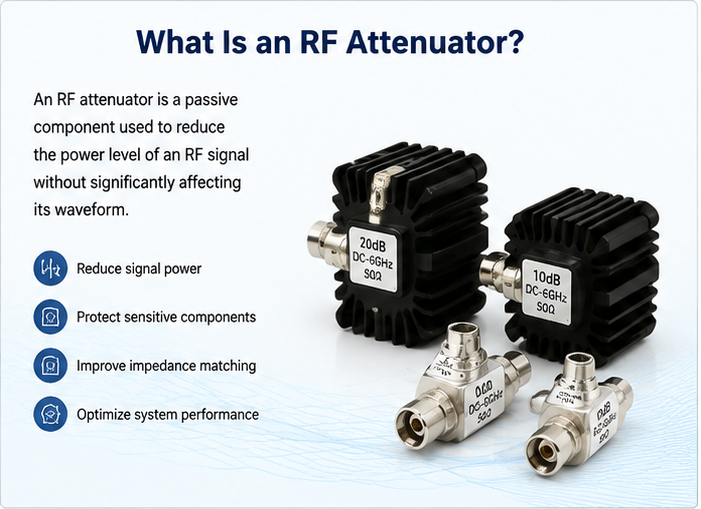
An RF attenuator is a passive microwave device designed to reduce the amplitude or power level of an RF signal without significantly affecting the waveform. Unlike amplifiers that increase signal strength, attenuators introduce controlled signal loss measured in decibels (dB).
RF attenuators are commonly used to protect sensitive components, improve impedance matching, control signal levels, and optimize system performance.
Key Parameters of RF Attenuators
- Attenuation Value: The amount of signal reduction, typically measured in dB.
- Frequency Range: The operating frequency capability of the attenuator.
- Power Handling: The maximum RF power the device can withstand.
- VSWR: Indicates impedance matching performance.
- Insertion Loss: Additional signal loss introduced by the device.
How Does an RF Attenuator Work?
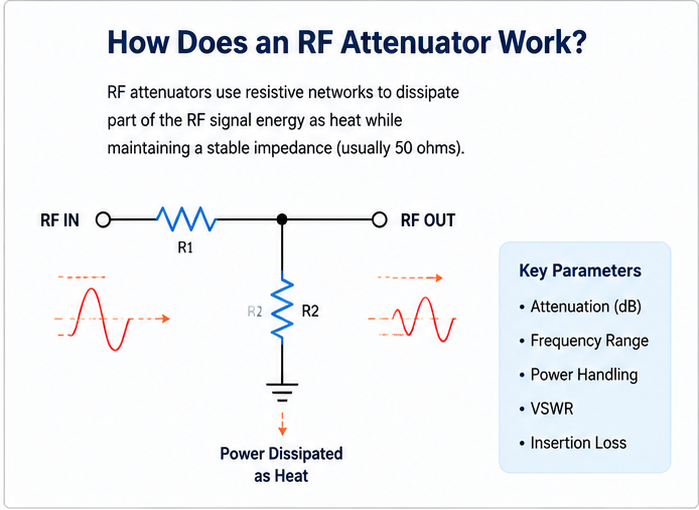
RF attenuators typically use resistive networks to dissipate a portion of the RF signal energy as heat. These networks are designed to maintain a stable impedance, usually 50 ohms, ensuring minimal reflection and maintaining system performance.
Common attenuation structures include T-type attenuators, Pi-type attenuators, and absorptive attenuator designs. The choice depends on frequency range, power requirements, and application conditions.
What Is a Fixed RF Attenuator?
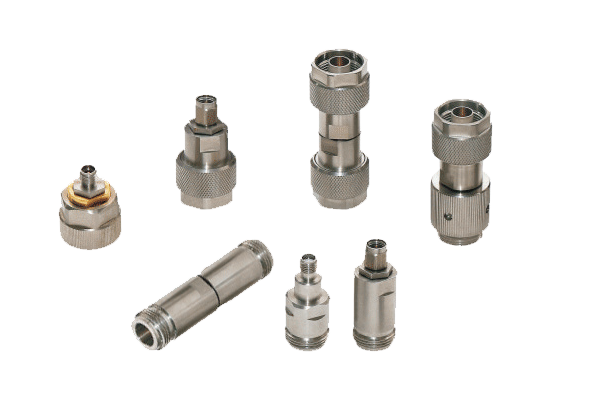
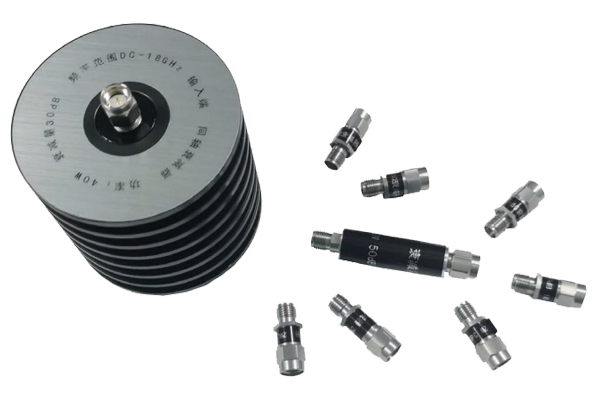
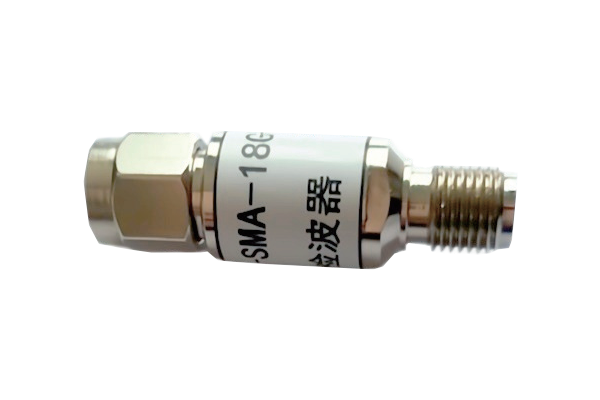
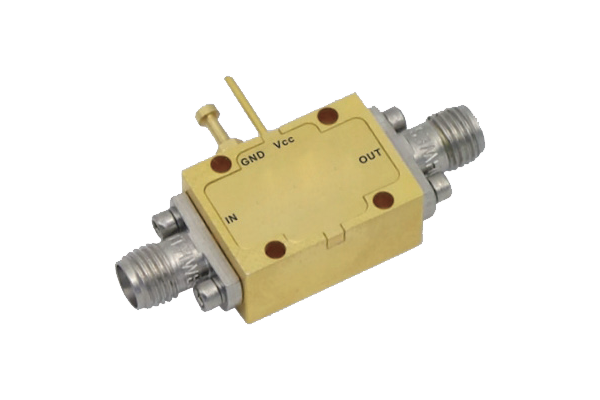
A fixed RF attenuator provides a constant attenuation value that cannot be adjusted after installation. For example, a 10 dB fixed attenuator will always reduce the input signal power by approximately 10 dB.
Advantages of Fixed Attenuators
- Simple and reliable design
- Excellent RF performance and stability
- Low insertion loss variation
- Compact size and cost-effective solution
- Suitable for high-frequency microwave applications
Common Applications of Fixed Attenuators
- RF test and measurement equipment
- Signal level adjustment
- Transmitter output protection
- Receiver input protection
- Microwave communication systems
What Is a Continuously Variable RF Attenuator?
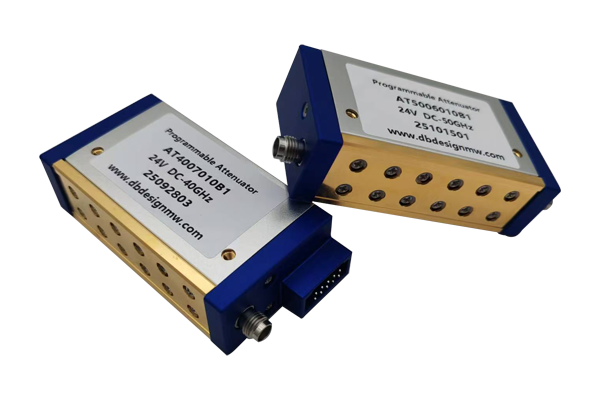
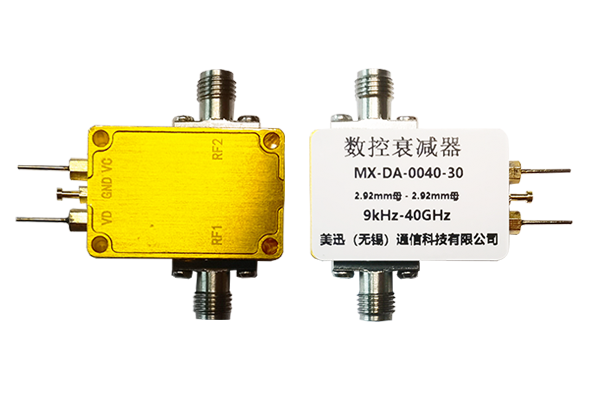
A continuously variable attenuator allows engineers to adjust attenuation levels continuously within a specific range. Instead of selecting a fixed attenuation value, users can fine-tune signal strength according to system requirements.
Variable attenuators are commonly controlled through mechanical adjustment, electronic control, voltage control, or digital interfaces.
Advantages of Continuously Variable Attenuators
- Flexible attenuation adjustment
- Ideal for dynamic RF systems
- Enables precise signal calibration
- Supports automated testing systems
- Useful in complex microwave networks
Common Applications of Variable Attenuators
- Automated RF test systems
- Wireless communication testing
- Radar and aerospace systems
- Satellite communication equipment
- Laboratory microwave measurement setups
Fixed vs. Continuously Variable RF Attenuators: Key Differences
| Feature | Fixed Attenuator | Continuously Variable Attenuator |
|---|---|---|
| Attenuation Adjustment | Fixed value only | Continuous adjustment range |
| Design Complexity | Simple structure | More complex mechanism |
| Cost | Lower cost | Higher cost |
| Signal Control | Limited control | High precision control |
| Reliability | Very high | Depends on adjustment method |
| Typical Usage | Permanent attenuation requirements | Dynamic signal adjustment |
How to Choose Between Fixed and Variable RF Attenuators?
Selecting the correct RF attenuator depends on application requirements, operating environment, and system design goals.
Choose a Fixed RF Attenuator When:
- The required attenuation value is known and stable.
- Maximum reliability is required.
- The system requires low-cost RF signal control.
- The attenuator will remain permanently installed.
Choose a Continuously Variable Attenuator When:
- Signal levels need frequent adjustment.
- Precise calibration is required.
- The system operates under changing RF conditions.
- Automated testing or control is needed.
Applications of RF Attenuators in Modern RF Systems
RF attenuators are widely used across multiple industries due to their ability to control signal power and improve system stability.
- Telecommunications: Signal balancing in wireless networks and base stations.
- Aerospace: RF control in satellite and avionics systems.
- Radar Systems: Signal calibration and receiver protection.
- RF Testing: Accurate measurement and equipment protection.
- Military Communications: Reliable signal management in demanding environments.
Conclusion
Both fixed and continuously variable RF attenuators are important components in modern microwave and RF systems. Fixed attenuators provide simplicity, reliability, and stable performance, making them ideal for applications requiring constant signal reduction. Continuously variable attenuators offer greater flexibility and precision for systems that require dynamic signal control.
By understanding the differences between these two types of RF attenuators, engineers can select the most suitable solution to achieve optimal signal performance, minimize losses, and improve overall RF system reliability.