What is the Difference Between, SPST, SPDT and DPDT?
Switches are described by how many independent circuits they control (poles) and how many positions each circuit can connect to (throws). Three of the most common configurations — SPST, SPDT, and DPDT — cover the majority of switching needs in electronics, instrumentation, and control systems.
Quick Answer
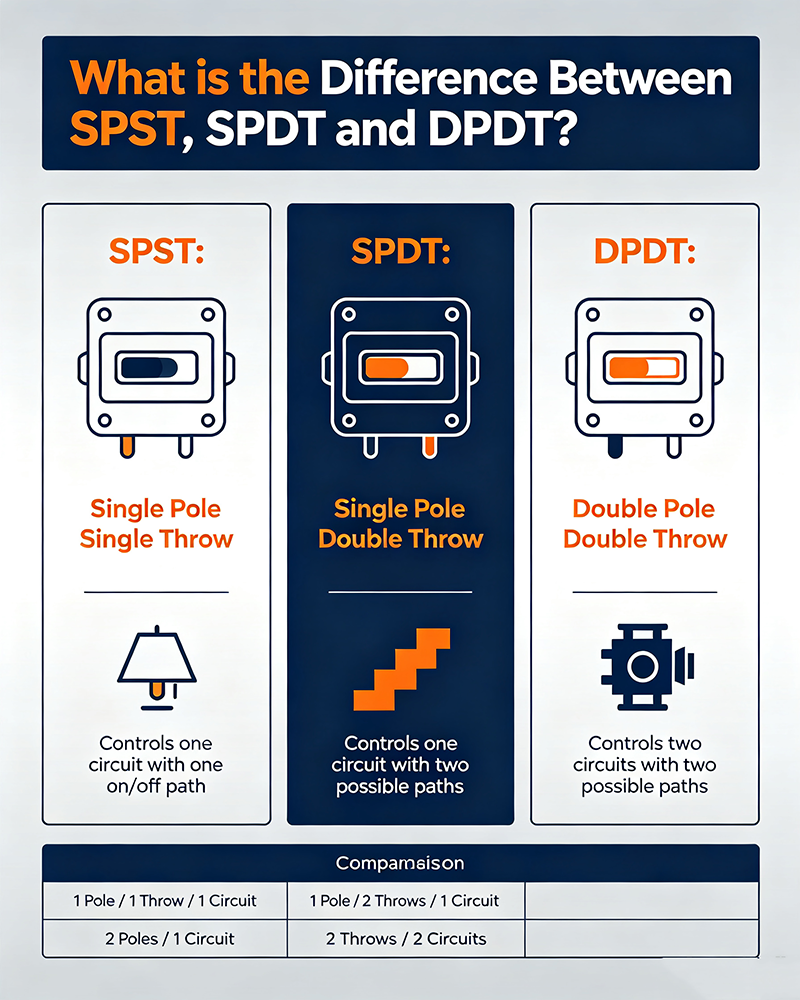
SPST (Single-Pole Single-Throw) is a simple on/off switch with one input and one output. SPDT (Single-Pole Double-Throw) routes one input to one of two outputs — like a light switch or selector. DPDT (Double-Pole Double-Throw) has two independent circuits, each switchable between two outputs — perfect for reversing polarity, switching between two sources, or H-bridge control.
What Are Poles and Throws?
The terms "pole" and "throw" describe the electrical structure of a switch:
Pole: the number of independent circuits the switch controls.
Throw: the number of positions each pole can connect to.
A switch with more poles can switch multiple signals simultaneously. A switch with more throws gives more routing options. Together, they define what a switch can do.
SPST — Single-Pole Single-Throw
SPST Schematic Symbol
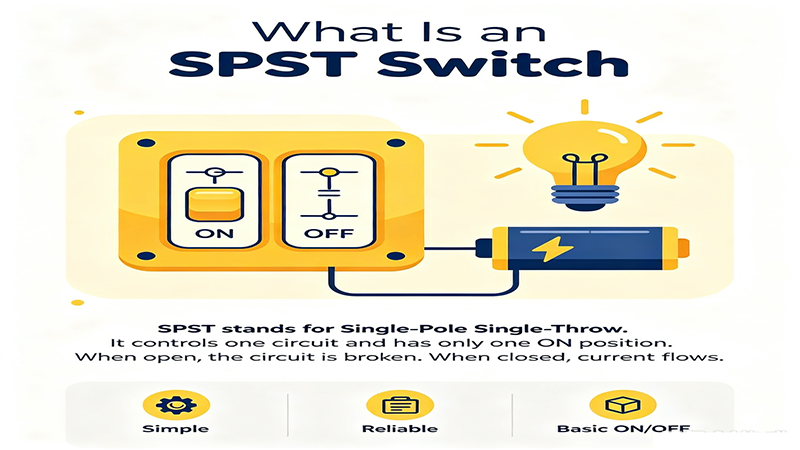
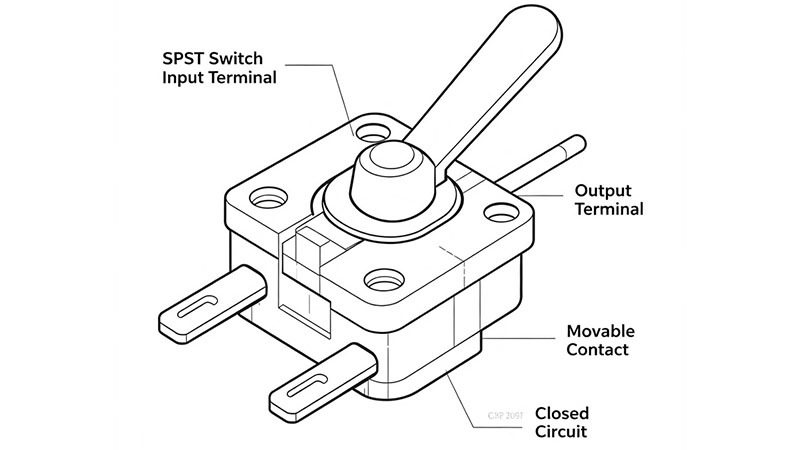
SPST has two terminals. When the lever is up (open), no current flows. When down (closed), Terminal A connects to Terminal B.
An SPST switch is the simplest form: a single pole that can be either open or closed. It functions exactly like a light switch in your home — on or off, no nothing to.
SPST Examples
Wall light switches.
Power buttons on consumer electronics.
Reset buttons.
Simple on/off control of a single load.
SPST Schematic
The SPST symbol shows two terminals connected by a switch lever. When the lever is drawn making contact, the switch is closed; when it is drawn angled away, the switch is open.
SPDT — Single-Pole Double-Throw
SPDT Schematic Symbol
SPDT has three terminals: one common and two throws. The lever routes the common to either T1 or T2.
An SPDT switch has one pole (one common input) and two throws (two selectable outputs). It selects between two destinations, like a railway switch routing a train.
SPDT Examples
Selector switches on instruments.
Light switches with two-way control.
Audio source selectors.
Changeover relays.
DPDT — Double-Pole Double-Throw
DPDT Schematic Symbol
DPDT has six terminals and operates two independent SPDT switches in sync, allowing polarity reversal or simultaneous routing of two circuits.
A DPDT switch has two poles and two throws. It is essentially two synchronized SPDT switches operated by one actuator. DPDT is useful when you need to switch two signals together — for example, reversing the polarity of a DC motor or switching between two audio sources and grounds simultaneously.
DPDT Examples
DC motor forward/reverse control.
Polarity reversal for electroplating or test equipment.
H-bridge driver replacement.
Switching between two signal sources on the same load.
Side-by-Side Comparison
SPST
2 terminals
On / Off only
Simplest switch
Common: light switch
SPDT
3 terminals
Selects A or B
Changeover
Common: source selector
DPDT
6 terminals
Two SPDT in sync
Reverses polarity
Common: motor reverse
Detailed Specification Table
Parameter
SPST
SPDT
DPDT
Number of Poles
1
1
2
Number of Throws
1
2
2
Number of Terminals
2
3
6
Switch States
2 (on/off)
2 (A or B)
2 (forward/reverse)
Circuits Controlled
1
1 of 2
2 of 2 simultaneously
Typical Use
Power on/off
Source selection
Polarity reversal
How to Choose the Right Switch
Decide how many circuits you need to control — that's your pole count.
Decide how many positions each circuit should connect to — that's your throw count.
Match the contact rating to the voltage and current of your load.
Choose action: momentary (spring-return) or maintained (latching).
Verify mechanical life matches your application's cycle count.
Tip: Use SPDT instead of SPST when you need to switch between two sources. Use DPDT when you need to reverse polarity or switch two independent signals together.
Other Common Configurations
Code
Name
Use
DPST
Double-Pole Single-Throw
Two simultaneous on/off switches
3PDT
Triple-Pole Double-Throw
Three synchronized SPDT switches (e.g., guitar wiring)
4PDT
Quad-Pole Double-Throw
Four synchronized SPDT switches
SP3T – SP12T
Multi-throw
Selectors with 3 – 12 positions (rotary switches)
Common Mistakes
Confusing pole with throw: SPST has 1 pole and 1 throw; DPDT has 2 of each.
Exceeding contact rating: arcing and contact welding.
Switching DC instead of AC: DC arcs are harder to extinguish; derate DC switch rating.
Wrong mechanical life: tactile switches may fail in continuous-use applications.
Forgetting off-state leakage: some semiconductor switches leak in the off state.
SPDT = single-pole double-throw (3 terminals, A or B selection).
DPDT = double-pole double-throw (6 terminals, two synchronized SPDT switches).
Match pole count to circuits and throw count to destinations.
Higher pole/throw counts are available for specialized applications.
Frequently Asked Questions
What is the simplest switch type?
SPST is the simplest: a single pole with one throw. It functions as a basic on/off switch and has only two terminals.
What is the difference between SPDT and DPDT?
SPDT has one pole switching between two throws. DPDT has two poles, each switching between two throws, all operated by one actuator. DPDT effectively gives you two synchronized SPDT switches.
Can DPDT reverse motor polarity?
Yes. By wiring the motor to one set of throws with reversed polarity on the other set, a DPDT switch flips the motor's direction with each throw.
What is a momentary switch?
A momentary switch returns to its default position when released — like a doorbell button. A maintained (latching) switch holds its position until actuated again — like a light switch.
Can I use a higher-rated switch than I need?
Yes. Using a higher voltage or current rating than required is generally safe and improves reliability. The reverse (using an underrated switch) is dangerous.
The main difference between SPST and DPDT switches is their number of poles and throws. The pole represents the number of independent circuits being controlled, while the throw represents the number of selectable connections for each pole.
Discover the benefits and applications of SPST switches in electrical systems. Learn how single-pole single-throw switches work, their advantages, common uses, and key selection criteria.
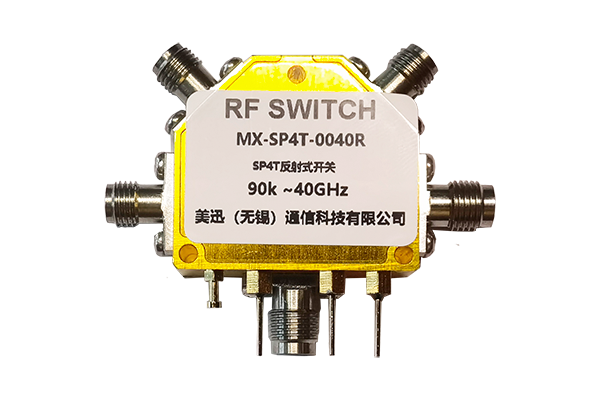
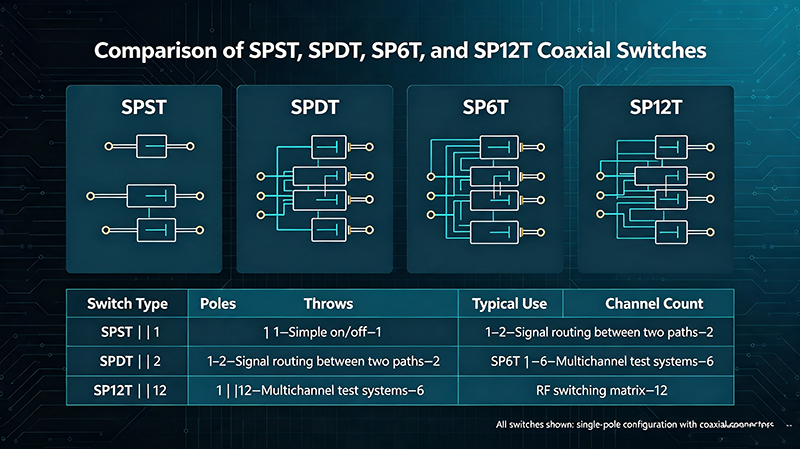
Coaxial switches are essential RF and microwave components used for signal routing, testing systems, communication equipment, radar applications, and measurement instruments.
Jul 23 ,26
About the Author — MeiXun Team
Wang
Chief Engineer Wang
High-tech Enterprise, Feifeng Talent
Chief Engineer Wang graduated with a master's degree in high-power microwave from the Institute of Electronics, University of Chinese Academy of Sciences.
View Full Profile
Wang
Chief Engineer Wang
High-tech Enterprise, Feifeng Talent
Chief Engineer Wang graduated with a master's degree in high-power microwave from the Institute of Electronics, University of Chinese Academy of Sciences.
In the same year, he joined CETC 40/41 for work and study. He has been committed to the design and development of microwave switches for a long time.
He has applied for 27 patents as the first inventor in the microwave switch field, with 6 authorized invention patents and 14 utility model patents.
The products he developed cover various application platforms such as civilian testing, vehicle-mounted, shipborne, airborne, and missile-borne.