






What are Directional Couplers
-
Working Principle
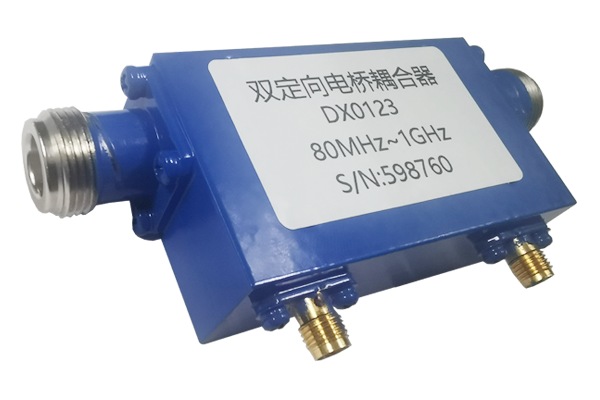
A directional coupler is a four-port passive microwave device whose core function is to distribute signal power in a specific ratio. When electromagnetic waves propagate in the main transmission line, a signal in a specific direction is excited in the secondary line through the coupling mechanism, achieving directional energy extraction. This selective transmission characteristic stems from a carefully designed internal coupling structure that ensures the signal flows along a predetermined path.
-
Structural Characteristics
This device typically consists of two parallel transmission lines, with their spacing precisely controlled to achieve the required coupling degree. Common implementations include microstrip lines, waveguides, and coaxial structures, with different topologies adapting to various frequency band requirements. The length of the coupling region is closely related to the center operating wavelength; quarter-wavelength designs are most common, while broadband applications use multi-section coupling structures to extend frequency coverage.
-
Performance Indicators
Key parameters for evaluating the quality of a directional coupler include coupling coefficient, directivity, isolation, and VSWR. Directivity characterizes the signal separation capability between the main and secondary line ports; ideally, unused ports should exhibit extremely high attenuation. Insertion loss reflects the energy dissipation of the signal through the main line, while the bandwidth range determines the type of communication system the device is suitable for.
-
Application Areas
In modern communication systems, directional couplers perform crucial functions such as power monitoring, signal sampling, and reflection measurement. Base station equipment uses them for transmit power detection, vector network analyzers rely on them to separate incident and reflected waves, and radar systems use them to build transmit-receive isolation channels. With the development of millimeter-wave technology, these devices are becoming increasingly important in satellite communication and autonomous driving perception links.