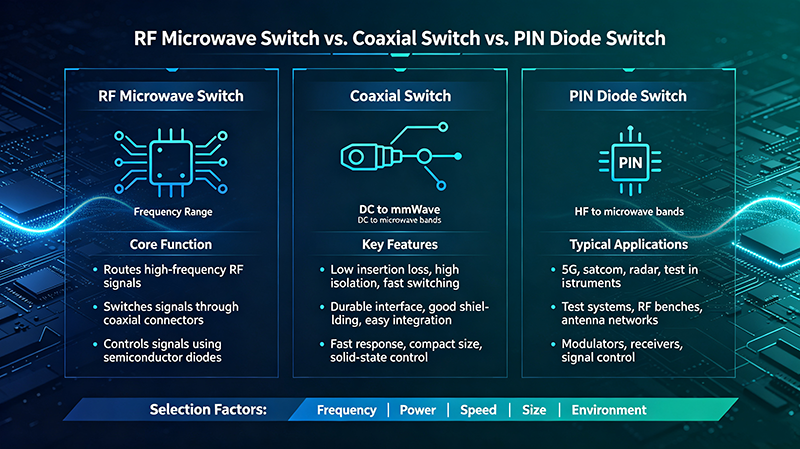


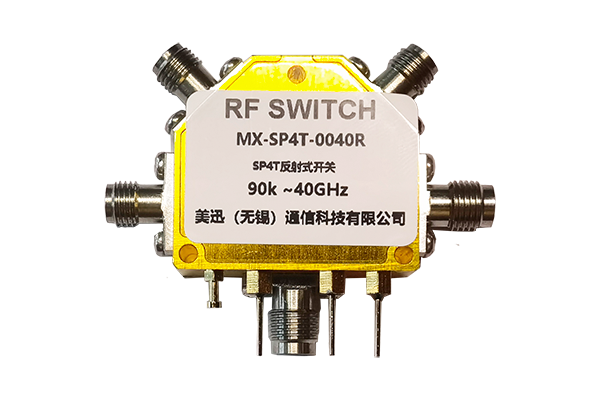
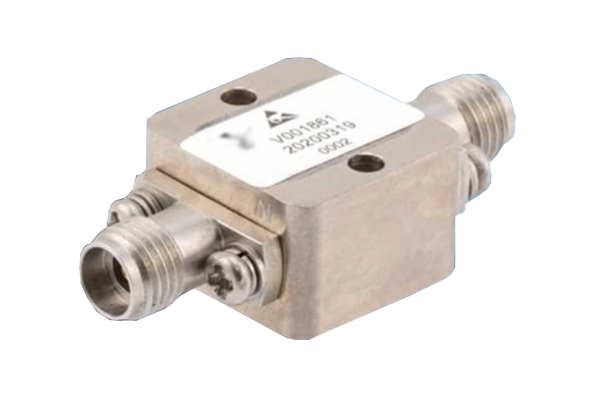
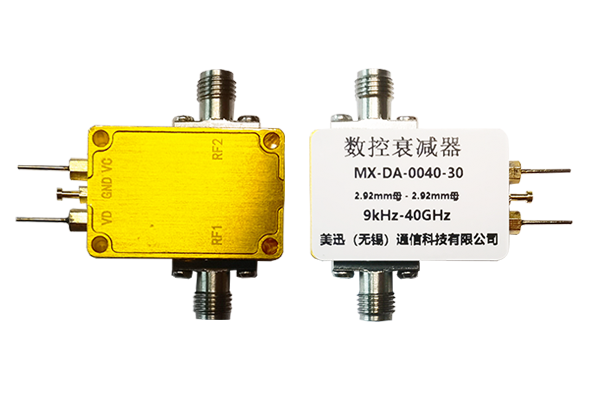
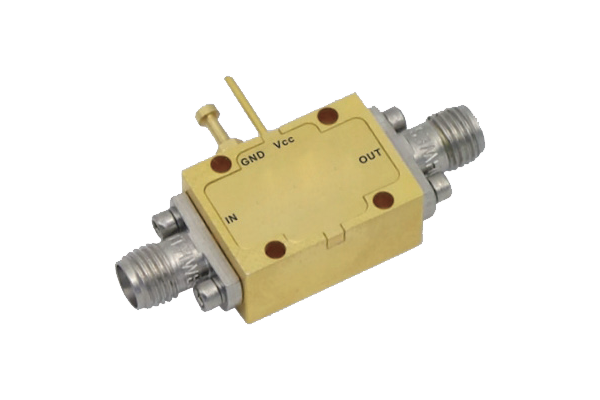
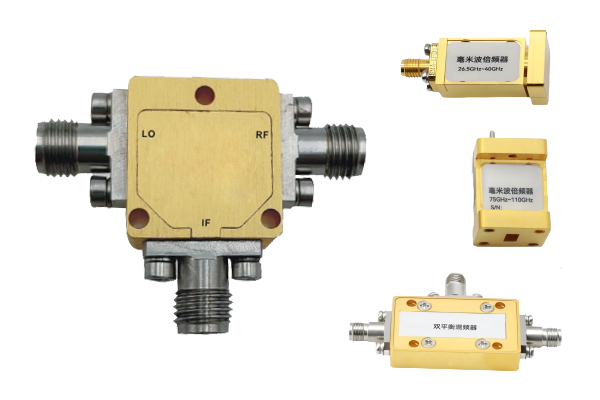




Choosing between a PIN diode switch and a coaxial switch is one of the most common decisions RF engineers face. Both technologies serve similar functions but excel in different scenarios. This comprehensive comparison will help you understand the strengths and limitations of each, enabling you to make the right choice for your specific application requirements.
Technology Overview
Before diving into the comparison, let's understand the fundamental operating principles of each technology.
PIN Diode Switch
Solid-State Technology
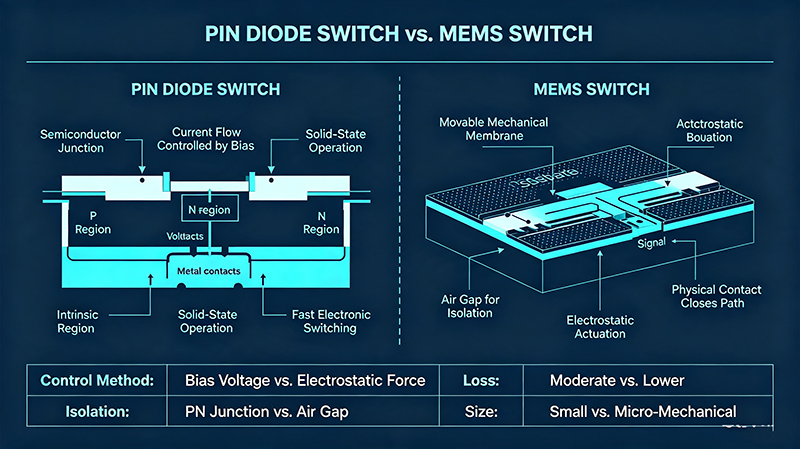
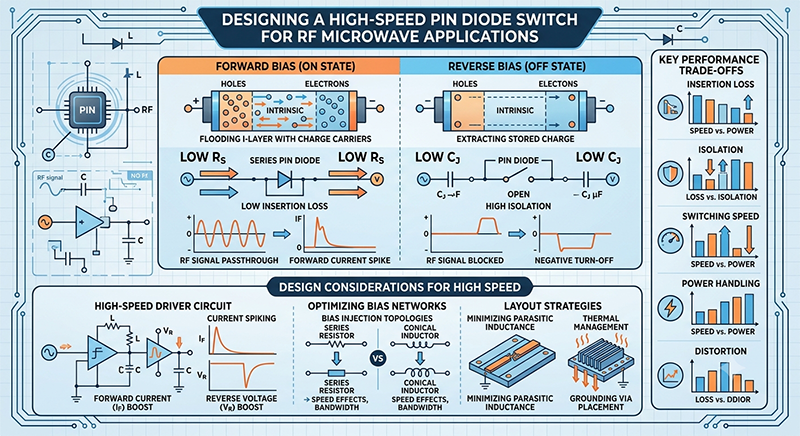
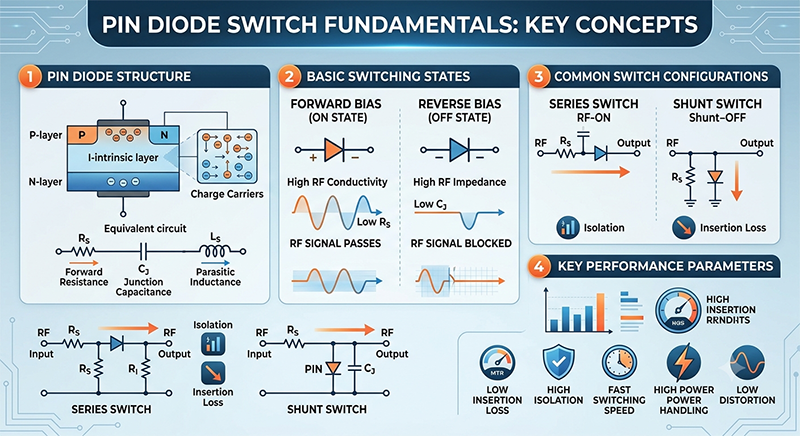
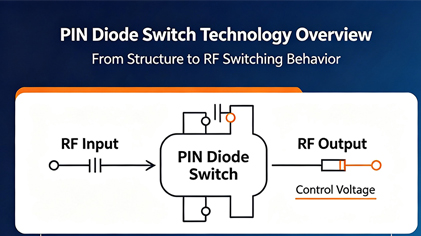
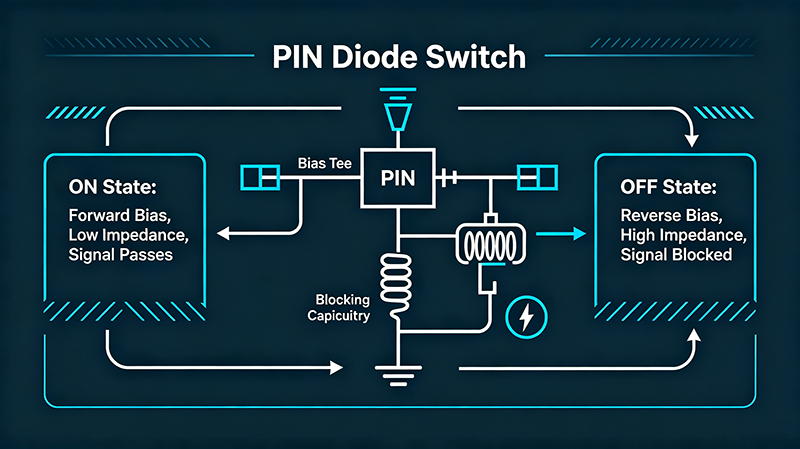
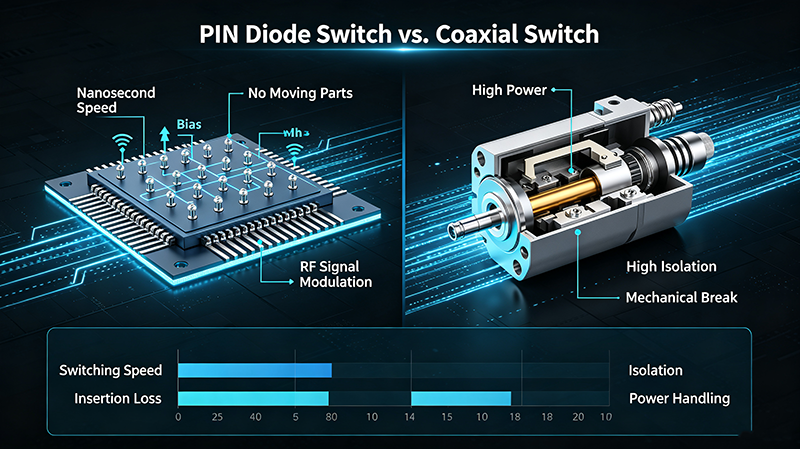
PIN diode switches use semiconductor devices with an intrinsic (I) region between P-type and N-type layers. Forward bias creates a low-impedance path, while reverse bias creates a high-impedance path, controlling RF signal flow electronically.
Key Characteristics
- Nanosecond switching speeds
- No moving parts
- Compact size
- Long operational life
- Silent operation
- Low power consumption
Coaxial Switch
Electromechanical Technology
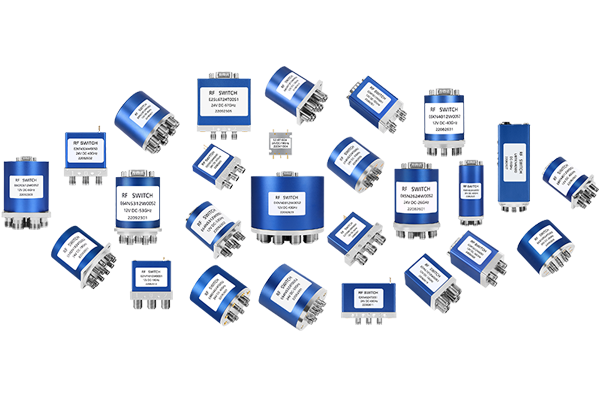
Coaxial switches use electromagnetic actuators to physically move RF contacts within a coaxial transmission line structure. The mechanical movement creates or breaks signal paths while maintaining 50-ohm impedance throughout.
Key Characteristics
- Millisecond switching speeds
- Physical relay contacts
- High power handling
- Excellent isolation
- Standard coaxial connectors
- Wide frequency range
Detailed Specification Comparison
| Parameter | PIN Diode Switch | Coaxial Switch |
|---|---|---|
| Switching Speed | 1 - 100 ns (nanoseconds) | 3 - 15 ms (milliseconds) |
| Frequency Range | 100 MHz - 50 GHz | DC - 67 GHz |
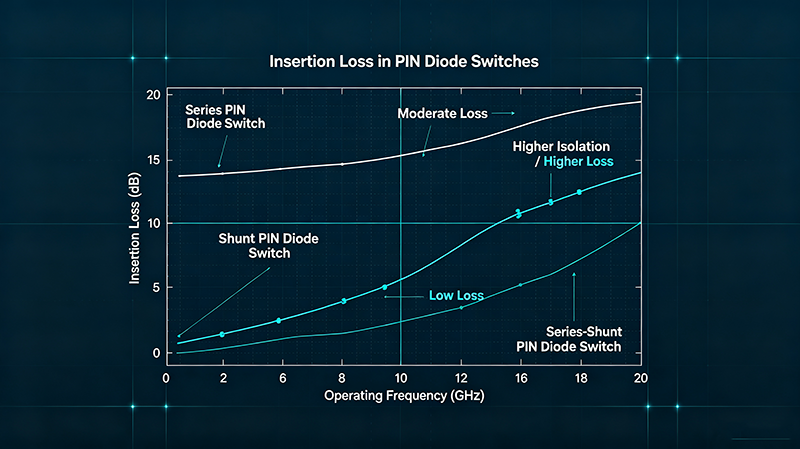
| Insertion Loss | 0.5 - 2.5 dB | 0.2 - 1.5 dB |
| Isolation | 30 - 60 dB | 60 - 90 dB |
| VSWR (Typical) | 1.3:1 - 1.8:1 | 1.1:1 - 1.4:1 |
| Power Handling (CW) | 0.1 - 50 W | 10 - 500 W |
| Peak Power | 10 - 200 W | Up to 5 kW |
| Operating Lifetime | 10^10+ cycles | 10^6 - 10^7 cycles |
| Switching Voltage | +5V to +28V DC | +12V to +28V DC |
| Switching Current | 5 - 50 mA | 50 - 200 mA |
| Size | Compact (mm-scale) | Medium to Large |
| Connector Type | Surface mount or leaded | SMA, N-Type, BNC, etc. |
| Cost Range | $5 - $500 | $100 - $3000+ |
| Operating Temperature | -40°C to +85°C (typical) | -55°C to +125°C |
Advantages of Each Technology
PIN Diode Switch Advantages
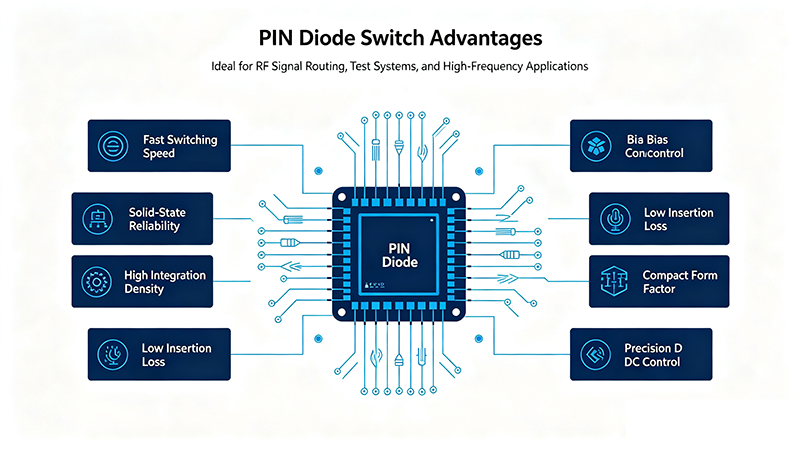
When PIN Diodes Excel
- Ultra-Fast Switching: Sub-microsecond switching enables rapid frequency hopping, TDD operation, and burst-mode applications
- Long Lifespan: No mechanical wear means virtually unlimited switching cycles
- Silent Operation: No mechanical clicking sounds, ideal for noise-sensitive environments
- Compact Size: Enables miniaturization and integration into dense RF modules
- Low Power Consumption: Minimal drive power required for switching control
- High Reliability: No moving parts means fewer failure modes and longer MTBF
- Excellent Linearity: Low intermodulation distortion preserves signal quality
- IC Integration: Can be integrated with other semiconductor circuits
Coaxial Switch Advantages
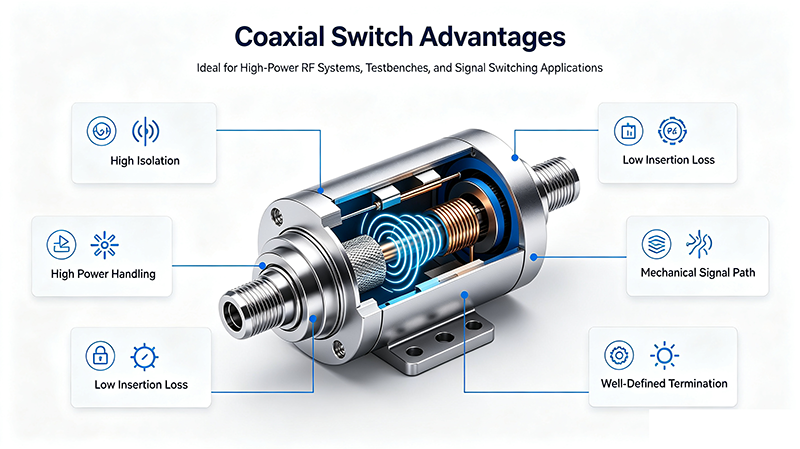
When Coaxial Switches Excel
- High Power Handling: Handles hundreds of watts of CW power and kilowatts of peak power
- Superior Isolation: 60-90 dB isolation protects sensitive receiver circuits
- Low Insertion Loss: 0.2-0.5 dB typical, preserving signal strength
- Wide Frequency Range: DC operation with coverage up to 67 GHz
- Easy Integration: Standard coaxial connectors simplify test setup
- High Reliability in Static Use: Excellent for infrequently switched applications
- Better for Manual Configurations: Ideal for lab and test bench applications
- Lower Noise Figure Impact: Lower loss means less NF degradation
Limitations to Consider
PIN Diode Switch Limitations
- Limited Power Handling: Not suitable for high-power transmitter applications
- Lower Isolation: May be insufficient for some sensitive receiver applications
- Higher Insertion Loss: 1-2.5 dB can be significant in noise-critical applications
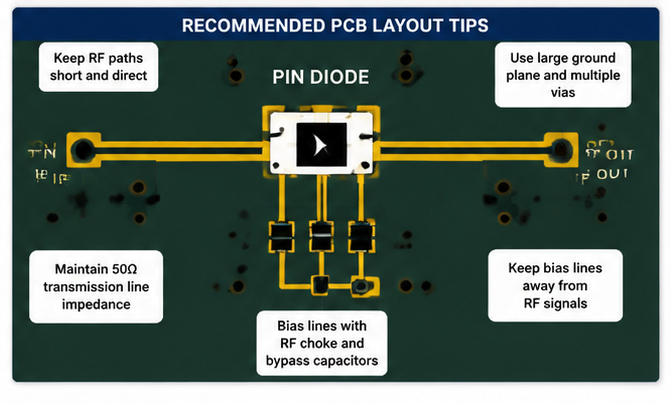
- Bias Circuit Required: Needs DC bias circuitry for proper operation
- Frequency Limitations: Performance degrades significantly at very high frequencies
- Temperature Sensitivity: Performance varies with temperature changes
Coaxial Switch Limitations
- Slow Switching: Millisecond switching unsuitable for fast applications
- Limited Mechanical Life: 1-10 million cycles requires eventual replacement
- Mechanical Wear: Contacts degrade over time and use
- Larger Size: Bulky compared to solid-state alternatives
- Higher Power Consumption: Significant coil current during switching
- Mechanical Noise: Audible clicking during operation
- Vibration Sensitive: Mechanical shock can affect operation
- Higher Cost: Premium price, especially for high-frequency models
Application-Specific Recommendations
Radar Systems
Phased array radars require thousands of switches with nanosecond switching speeds. PIN diodes are the only practical choice for T/R modules in modern radar systems.
5G Mobile Devices
Smartphones need fast, compact, low-power switches for antenna switching, carrier aggregation, and TDD operation. PIN diodes fit perfectly in mobile designs.
Electronic Warfare
EW systems need rapid frequency hopping and signal routing. PIN diodes enable the fast switching required for modern electronic countermeasures.
Test & Measurement
Lab equipment and production test systems benefit from coaxial switches' high isolation, easy connector integration, and low insertion loss for accurate measurements.
High-Power Transmitters
Broadcast transmitters and high-power amplifiers require switches that can handle hundreds of watts. Coaxial switches are the only option for these applications.
Satellite Ground Stations
Satellite communication systems benefit from coaxial switches' low loss and high isolation for switching between antennas, polarizations, and frequency bands.
Antenna Selection
Antenna switching systems can use either technology depending on switching speed requirements, power levels, and integration constraints.
IoT Devices
Simple IoT devices with infrequent switching may use coaxial switches, while complex IoT gateways with frequent switching benefit from PIN diodes.
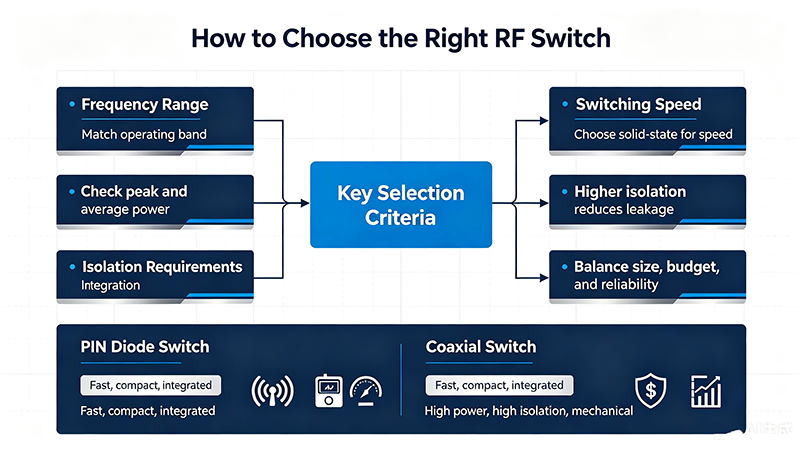
Decision Framework
Use this decision tree to determine which switch technology is best for your application:
Choose Your RF Switch
Question 1: Do you need sub-microsecond switching?
If YES (radar, fast frequency hopping, TDD systems) → Choose PIN Diode Switch
If NO, proceed to Question 2
Question 2: Is your RF power above 50W CW?
If YES (high-power transmitters, broadcast) → Choose Coaxial Switch
If NO, proceed to Question 3
Question 3: Do you need isolation above 60 dB?
If YES (sensitive receivers, high dynamic range) → Choose Coaxial Switch
If NO, proceed to Question 4
Question 4: Do you need DC to high frequency in one switch?
If YES (broadband test, multi-band systems) → Choose Coaxial Switch
If NO, proceed to Question 5
Question 5: Will the switch operate more than 10 million times?
If YES (frequent switching applications) → Choose PIN Diode Switch
If NO, choose based on size, cost, and integration requirements
Question 6: Is size and integration the top priority?
If YES (compact designs, mobile devices) → Choose PIN Diode Switch
If NO (lab applications, test benches) → Choose Coaxial Switch
General Rule of Thumb
Choose PIN diode switches for speed-critical, frequently-switched applications where size and integration matter. Choose coaxial switches for high-power, high-isolation applications where easy connectorization and low insertion loss are priorities.
Frequently Asked Questions
Conclusion
Choosing between PIN diode and coaxial switches requires careful consideration of your application's specific requirements. PIN diode switches excel in speed-critical, compact, and frequently-switched applications like radar, mobile devices, and electronic warfare. Coaxial switches dominate in high-power, high-isolation, and test-oriented applications.
Use the decision framework provided in this guide to systematically evaluate your requirements. Consider the priority order: switching speed, power handling, isolation, frequency range, lifetime, and finally size and cost. The right choice balances all these factors for your specific use case.
Both technologies will continue to play important roles in RF systems. PIN diodes are evolving with better power handling and lower loss, while coaxial switches are becoming more reliable and offering wider frequency ranges. Understanding both technologies helps you select the optimal switch for current and future RF applications.
Need Help Choosing the Right RF Switch?
Our technical team can help you evaluate PIN diode and coaxial switches for your specific application requirements.
Contact Our Technical Team