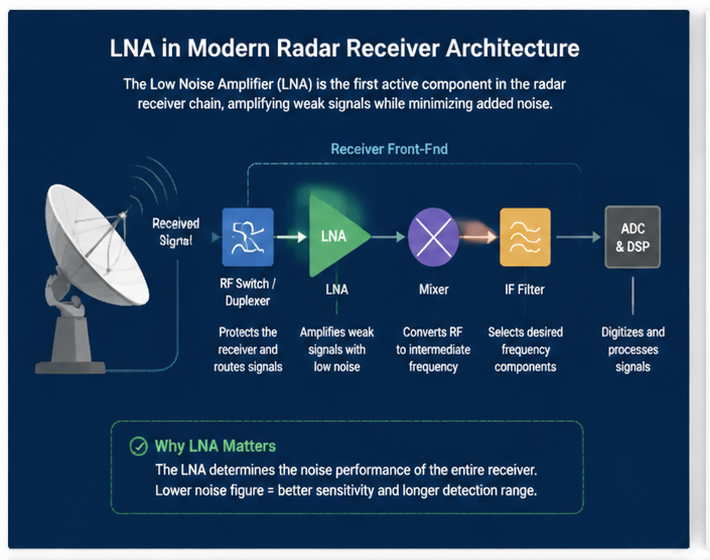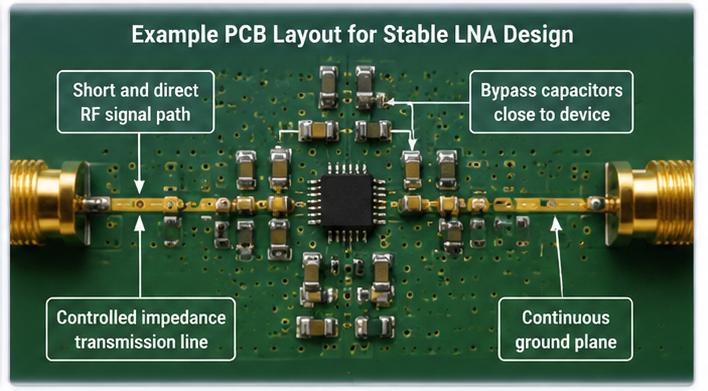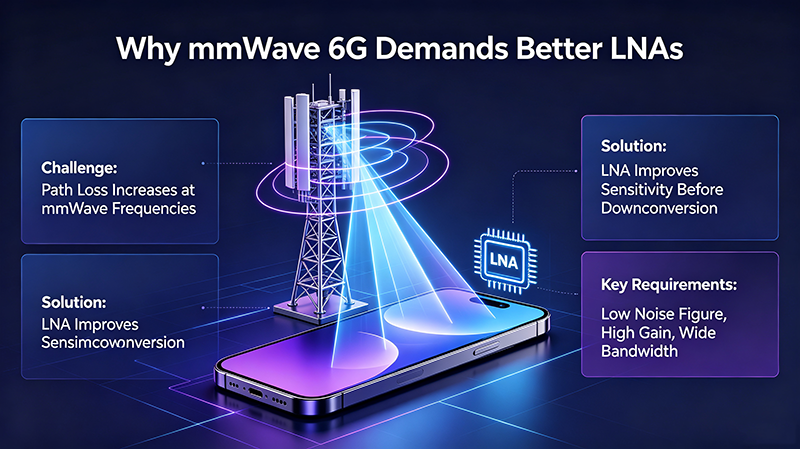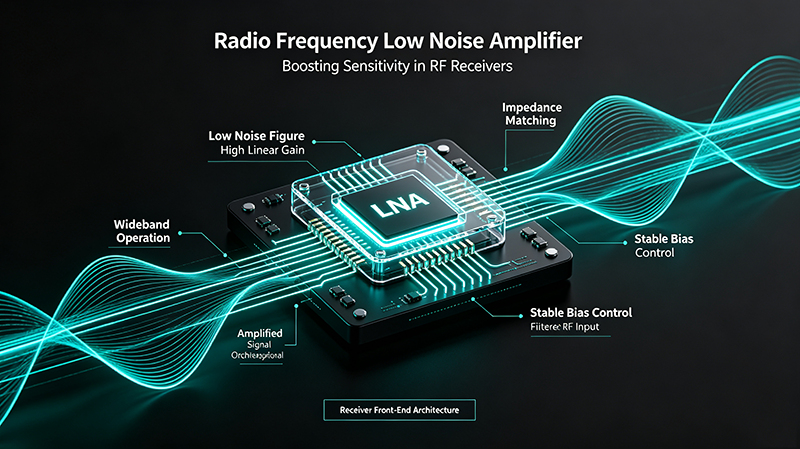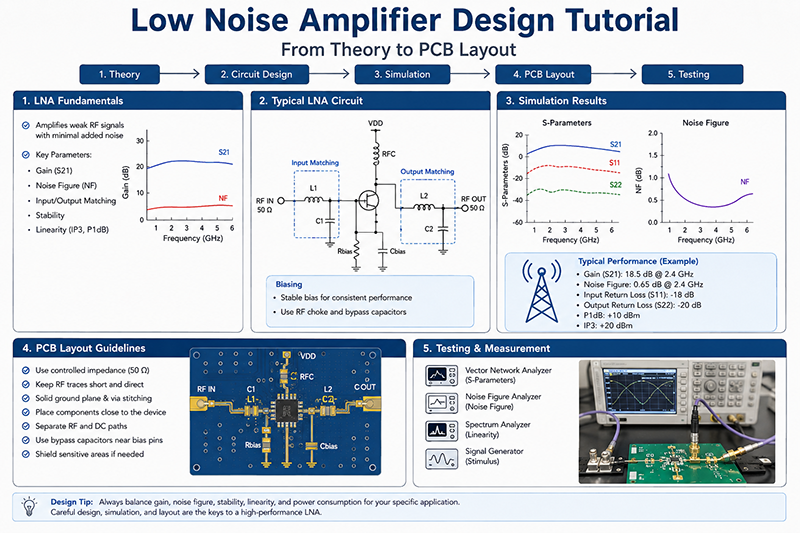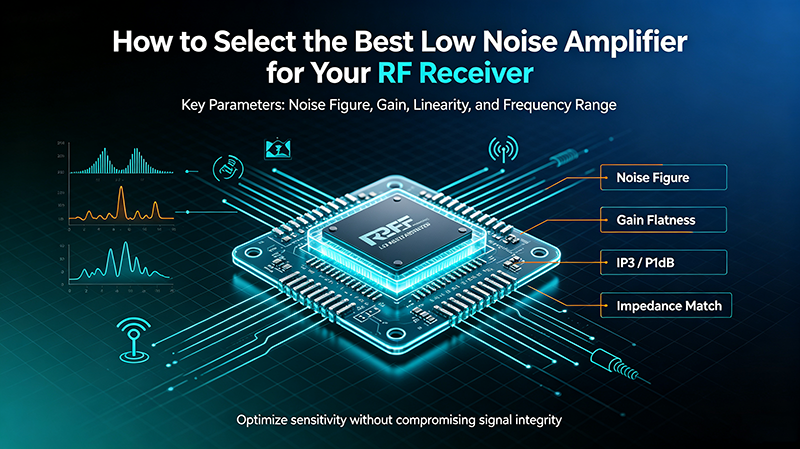


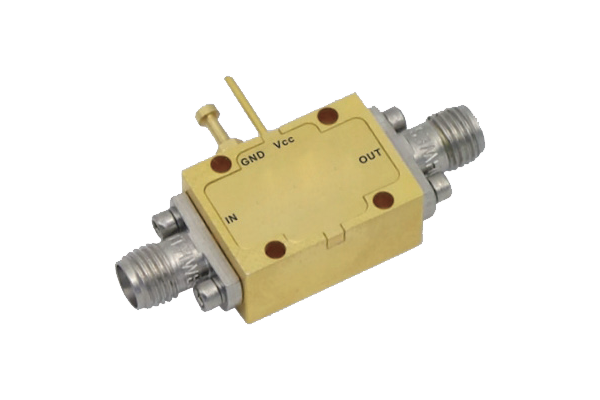
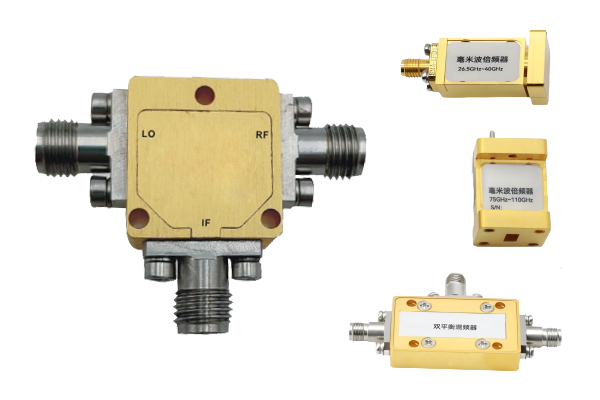
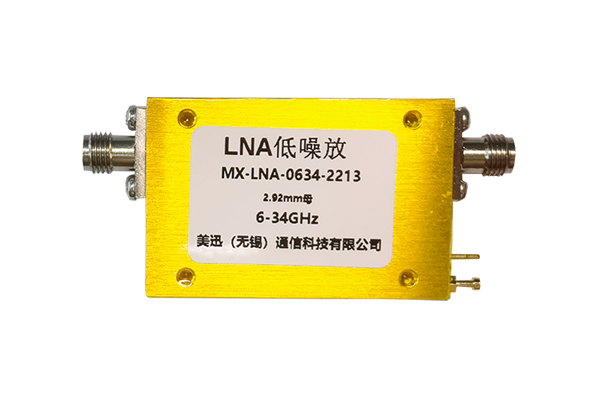
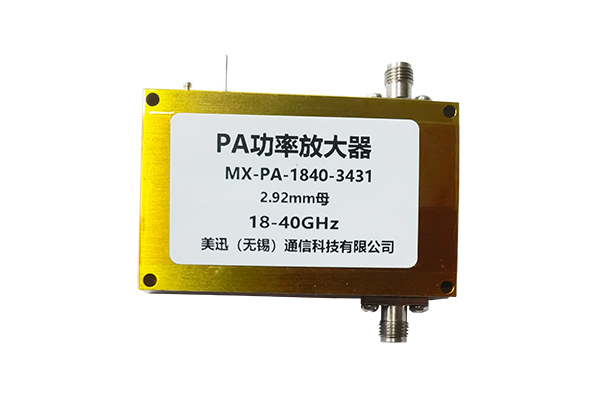
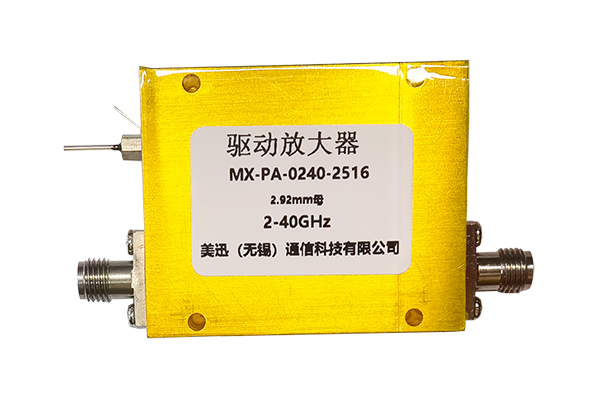




Selecting the right Low Noise Amplifier (LNA) for your application requires understanding both fundamental performance parameters and the latest industry developments. This 2026 buying guide covers the six most critical LNA parameters, explains emerging technology trends, and provides practical selection advice to help you make informed purchasing decisions.
2026 LNA Market Overview
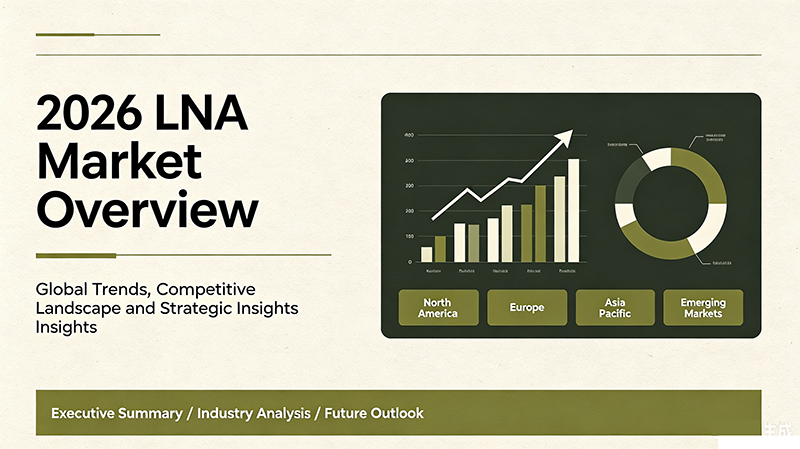
The global Low Noise Amplifier market is projected to reach $4.8 billion in 2026, driven by expanding 5G networks, satellite constellation deployment, automotive radar, and IoT proliferation. Key developments include GaN technology adoption, integrated front-end modules, and AI-optimized designs.
Engineers now have access to LNAs with noise figures below 0.5 dB for premium applications, integrated functions that reduce component count, and specialized designs optimized for mmWave frequencies above 24 GHz. Understanding both the parameters and trends is essential for making optimal purchasing decisions.
Noise Figure (NF)
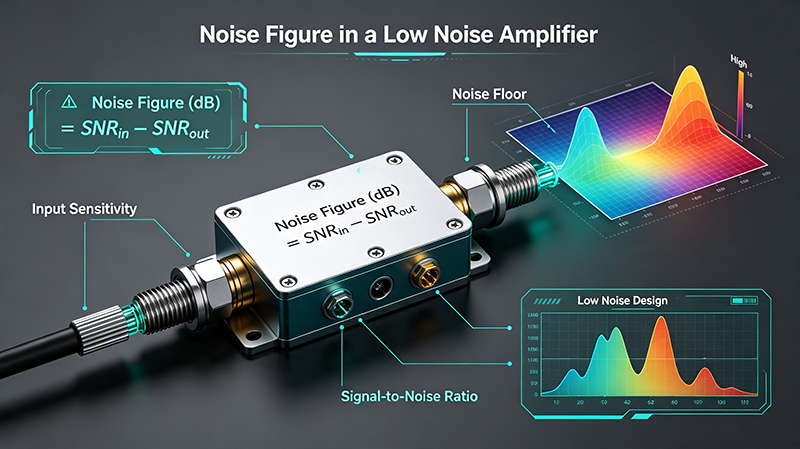
Noise Figure remains the most critical LNA parameter, directly determining receiver sensitivity. It measures the noise added by the amplifier relative to input noise.
Selection Guidelines by Application
| Application | Recommended NF | Technology Preference |
|---|---|---|
| Satellite Communications | <0.5 dB | InP HEMT, GaAs pHEMT |
| Radar Receivers | 0.5-1.0 dB | GaAs pHEMT, GaN |
| 5G Infrastructure | 0.6-1.5 dB | GaAs HEMT, SiGe |
| IoT/Wireless Sensors | 1.5-3 dB | CMOS, SiGe |
Gain and Gain Flatness
Gain determines how much the LNA amplifies the input signal, while gain flatness measures variation across the operating frequency range. Adequate gain ensures subsequent stage noise contributions are negligible.
Gain Considerations
- Excessive Gain: May cause compression, oscillation, or intermodulation
- Insufficient Gain: Next stage noise dominates system NF
- Gain Flatness: Important for broadband and multi-carrier signals
- Gain Stability: Must be stable across temperature and bias variations
Linearity (IP3 and P1dB)
Linearity specifications define how the LNA handles large signals without distortion. Critical for systems with strong interferers or high-order modulation.
Linearity Technology Comparison
GaN Advantages
- Highest IP3 performance
- Excellent for high-OIP3 applications
- Better for 5G with high modulation
- Handles stronger blockers
GaAs Trade-offs
- Lower NF than GaN
- Better for sensitive receivers
- More mature technology
- Lower power consumption
2026 Trend: GaN LNAs in 5G
GaN technology is increasingly being adopted for 5G massive MIMO base stations due to superior linearity. With 256-QAM and 1024-QAM modulation requiring extremely low EVM, GaN LNAs deliver the linearity needed for next-generation wireless infrastructure.
Frequency Range
Operating frequency range defines the bandwidth over which the LNA provides acceptable performance. Modern applications span from sub-6 GHz through mmWave.
Key Frequency Bands in 2026
| Band | Frequency | Application | LNA Technology |
|---|---|---|---|
| L-Band | 1-2 GHz | GPS, GNSS | GaAs, SiGe |
| S-Band | 2-4 GHz | Wi-Fi, Radar | GaAs pHEMT |
| C-Band | 4-8 GHz | 5G Sub-6 | GaAs HEMT |
| Ku-Band | 12-18 GHz | Satcom | GaAs, GaN |
| Ka-Band | 26-40 GHz | 5G mmWave | InP, GaN |
| V-Band | 50-75 GHz | 6G Research | Advanced GaN |
Power Consumption
Power consumption directly impacts thermal management, battery life, and operating costs. Modern applications demand increasingly efficient LNAs.
Power-Saving Technologies in 2026
- Bias Optimization: Adaptive bias circuits reduce idle consumption
- Sleep Modes: LNAs with sub-microamp standby modes for IoT
- Digital Control: Programmable gain and power states via digital interfaces
- Efficient Materials: Advanced GaN processes with higher efficiency
Massive MIMO Power Challenge
A 64T64R massive MIMO antenna contains 64 LNAs. At 100 mW per LNA, total LNA power consumption reaches 6.4W. This makes LNA efficiency critical for base station thermal design and operating costs.
Package and Integration
Modern LNA packages integrate multiple functions, reduce board space, and simplify assembly. Package selection affects performance, size, and cost.
Integration Trends in 2026
- Front-End Modules: LNA + Filter + Switch integrated in single package
- Multi-Channel LNAs: 2, 4, or 8 LNAs in one package
- Digital Interface: SPI/I2C controlled gain and bias settings
- Embedded Matching: Internal matching networks eliminate external components
2026 Industry Trends and Latest Developments
The LNA market in 2026 is characterized by several important trends that influence purchasing decisions. Understanding these trends helps future-proof your designs.
1. GaN Technology Expansion
GaN-on-SiC and GaN-on-Si processes are enabling lower-cost GaN LNAs for commercial applications beyond traditional defense markets. Expect GaN LNAs in more 5G and satellite products.
2. AI-Optimized Designs
Machine learning tools are being used to optimize LNA matching networks and bias circuits, delivering better performance than traditional manual optimization approaches.
3. 6G Research Components
Sub-THz LNAs for 6G research at 140-300 GHz are emerging from research labs, though commercial availability remains limited.
4. Sustainability Focus
Lower-power LNAs with reduced carbon footprint are increasingly important. Manufacturers are designing for energy efficiency throughout product lifecycle.
5. Software-Defined LNAs
Digitally controlled LNAs with programmable frequency response, gain, and bias settings enable software-defined radio and adaptive RF systems.
6. Automotive Radar Growth
77/79 GHz automotive radar LNAs with enhanced reliability and longer automotive qualification cycles are driving new product development.
Technology Comparison 2026
| Technology | NF | Frequency | Linearity | Power | Cost |
|---|---|---|---|---|---|
| GaAs pHEMT | Excellent | DC-50 GHz | Good | Low | Medium |
| GaN HEMT | Good | DC-40 GHz | Excellent | Higher | Higher |
| InP HEMT | Best | DC-100 GHz | Good | Low | High |
| SiGe BiCMOS | Good | DC-30 GHz | Good | Medium | Low-Med |
| CMOS | Moderate | DC-20 GHz | Moderate | Lowest | Lowest |
LNA Selection Checklist
Before Purchasing Your LNA
- Define your minimum NF requirement based on system sensitivity budget
- Determine gain needed to suppress subsequent stage noise
- Calculate required IP3 based on expected signal levels
- Verify frequency range covers all operating bands
- Evaluate power consumption against thermal budget
- Consider package size and integration level
- Review reliability and qualification standards
- Compare lifecycle costs, not just unit price
- Check manufacturer support and documentation quality
- Verify availability and lead times for production
Common Mistakes to Avoid
Frequently Asked Questions
Conclusion
Selecting the right Low Noise Amplifier in 2026 requires balancing multiple parameters while staying current with industry trends. The six key parameters covered in this guide—noise figure, gain, linearity, frequency range, power consumption, and package integration—form the foundation of LNA selection decisions.
As 5G, satellite communications, automotive radar, and IoT applications continue to evolve, GaN technology, integrated modules, and AI-optimized designs are shaping the future of LNA development. Understanding these trends helps make forward-looking purchasing decisions that will support your products over their full lifecycle.
Use the selection checklist and FAQ guidance to ensure your next LNA purchase meets current needs while accommodating future requirements. The right LNA choice provides performance headroom while maintaining reliability and cost-effectiveness throughout your product's lifecycle.
Need Help Selecting the Right LNA?
Our engineering team can help you navigate the 2026 LNA landscape and select the optimal component for your specific application requirements.
Contact Our Technical Team