


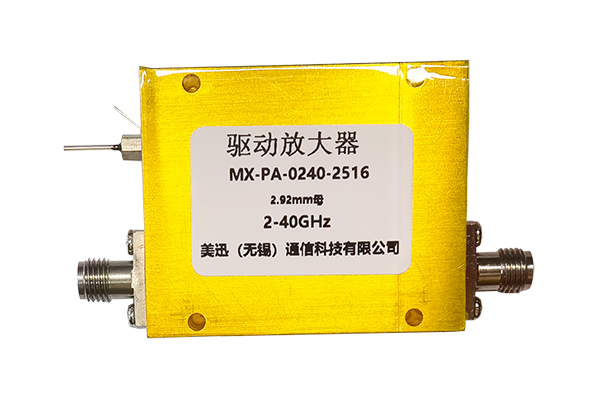




How Important is the Linearity of an RF Low Noise Amplifier
-
1Ensuring Fidelity in Signal TransmissionLinearity is a core prerequisite for ensuring complete signal transmission. Insufficient linearity in a Low Noise Amplifier (LNA) will cause distortion of the input signal, introducing new frequency components and compromising the integrity of the original signal. Especially in complex signal scenarios, distorted signals can interfere with each other, making it impossible for subsequent demodulation stages to accurately reconstruct the original information. Good linearity allows the amplifier's output signal to maintain a stable ratio with the input signal, avoiding signal distortion and ensuring the accuracy of information transmission.
-
2Improving Overall System PerformanceLinearity directly affects the overall performance of the RF system. In the receiving link, the LNA, as a core front-end component, will have insufficient linearity, reducing the system's dynamic range, causing saturation distortion with strong input signals, and affecting the receiving sensitivity of weak signals. Excellent linearity can widen the system's dynamic range, allowing the amplifier to accurately amplify weak signals and stably process strong signals, ensuring the entire RF system operates stably and efficiently in complex signal environments.
-
3Adapting to Diverse Application ScenariosThe quality of linearity determines the application adaptability of the LNA. In diverse scenarios such as communications, radar, and satellite, the signal environment is complex and ever-changing, encompassing both weak target signals and strong interference signals. Insufficient linearity can lead to amplifier distortion under strong interference, failing to meet the signal processing requirements of specific scenarios. Low-noise amplifiers with high linearity can adapt to the signal characteristics of different scenarios, effectively resist interference, ensure signal processing quality in various applications, and improve the environmental adaptability of equipment.
-
4Control System Design CostsGood linearity can reduce the overall design cost of RF systems. If the linearity of the Low Noise Amplifier is insufficient, additional filtering and correction devices must be added in subsequent links to compensate for signal distortion, increasing the hardware complexity and design difficulty, and raising R&D and manufacturing costs. High-linearity amplifiers can reduce the use of subsequent compensation devices, simplify the system architecture, reduce the difficulty of hardware selection and debugging, and reduce performance loss caused by signal distortion, indirectly reducing system maintenance costs and improving the overall design economy.
The linearity of a Low Noise Amplifier is fundamental to RF system performance, affecting signal fidelity, system dynamic range, application adaptability, and overall design costs. Investing in high-linearity LNAs ensures optimal performance across diverse applications while controlling long-term system expenses.