






Advantages of a Dual Directional Coupler
1. Bidirectional Sampling Advantage
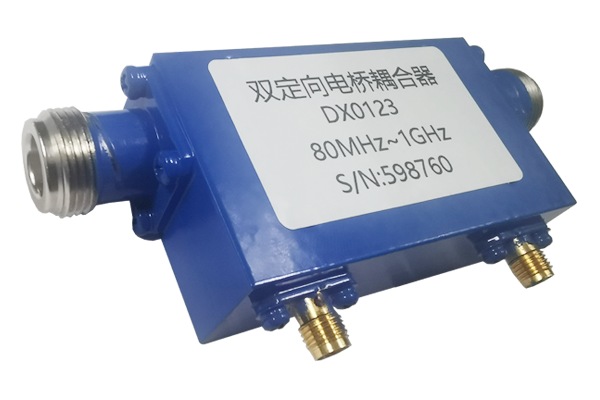
- The most prominent advantage of the bidirectional directional coupler is its bidirectional sampling capability.
- Compared to ordinary couplers that can only extract signals in one direction, it can simultaneously and accurately capture forward and reverse RF signals.
- Without adding additional equipment, it can achieve synchronous sampling of bidirectional signals, simplifying the system structure and providing comprehensive data support for signal analysis.
- It avoids signal monitoring blind spots caused by unidirectional sampling and adapts to more complex signal monitoring scenarios.
2. Signal Isolation Advantages
- It possesses excellent signal isolation performance, effectively separating forward and reverse signals to prevent interference between the two directions, ensuring the purity and accuracy of the sampled signal.
- Simultaneously, it effectively isolates the main line from the sampling branch, preventing signal feedback from the sampling link from affecting the main signal transmission.
- It reduces signal loss, ensures the stability of the main signal, and provides a reliable signal source for downstream detection equipment.
3. Adaptability Advantages
- The bidirectional directional coupler has extremely high adaptability, flexibly adapting to different RF systems and application scenarios.
- It can meet both conventional signal transmission and monitoring needs, as well as special scenarios such as high-frequency and complex interference.
- Its compact design and convenient installation allow for rapid integration and use without significant modifications to the existing system, greatly reducing the cost of system upgrades and modifications, and making it widely applicable.
4. Stability Advantages
- It possesses excellent operational stability, maintaining stable performance parameters under different temperature and humidity conditions, and is not easily affected by external environmental interference.
- It also features low loss, high durability, and long-term stable operation, reducing equipment failure and maintenance frequency, and lowering long-term operating costs.
- In addition, its performance parameters are highly consistent, which ensures the stability of signal transmission and monitoring and improves the operational reliability of the entire radio frequency system.